Showing posts with label bees. Show all posts

Tuesday, March 20, 2012

Howling Winds

 One look at the neighbor's flag yesterday and I knew it wasn't going to be a clean the chicken coop day.
 Nope, the Wyadotte rooster we put in the hen house Sunday just about got his feathers blown off. So chicken coop cleaning will be reserved for another day. I don't relish being slapped with chicken manure in the face as I'm shoveling it into the pickup even if the garden is waiting for it.
I know it is a bit early according to our usual spring schedule but the Canadian geese have been coming north in droves for a good month now. I heard a Meadow Lark sing a few days ago and the Horned Larks are back too. Early, yes, but it must mean spring is right around the corner for surely the birds wouldn't lie and that must mean I need to up my schedule for hatching chicks and starting plants for the garden.

 And if the birds weren't enough indication, Sherman (the rooster)  {note how he is sidled up to Bella (kid goat)} has now all but abandoned the goats for our one black hen that runs loose. He also challenges the roosters through the wire of their coop, something he didn't do before. Yup, the rooster that didn't pay any attention to the neighbor's hen, Goldy, when she made advances is now all a flutter with hormones, so it's got to be time to put in a rooster in the hen house.

We house our roosters separately from our hens because they pester them unmercifully and they pull out feathers which the hens need with our cold winters. We kept three roosters this year to give eachh other company and warmth for the cold winter we didn't get this year and I'm grateful for.The extra two roosters will end up being chicken noodle soup soon and as for the one in the coop, he'll eventually go to the same fate. The older the rooster, the less sperm. One year old hens and one year old roosters being the most fertile.

In a couple weeks, I'll start putting eggs in the incubator to hatch. Just one batch this year if all goes well. The grand kids will be thrilled. It is one of their favorite things, watching chicks peck their way out of the shell. Got to love Grandma's house. LOL
 And while I'm speaking of critters. Chicory gives a big thank you to all those willing her a speedy recovery. She is feeling much better and is back to standing upright, though still a bit tender on her feet. The total of medications ended up being two anti-biotic shots and three doses of calcium drench given 12 hours apart. She must not of suffered too much because she is milking up a storm. I credit that to her being in excellent condition before this occured.
And what were her kids doing while the wind was howling, not playing on the upturned rubber watering pale, nope, hiding out in the goat shed. Big ole ears like these take flight in such howling winds and who knows who they might take with them. LOL
What are the bees doing in all the warm weather? They are doing spring cleaning. This is the time they remove all the bee poop, dead bees, and the like from their hives. I've given them a little sugar water as a refreshing snack. But yesterday they stayed tucked inside as the wind would blow them into the next county, so instead they just tipped toed to the entrance to grab a quick sip.  

Is spring early where you are, or for those of you down under, is fall early this year?

Monday, October 24, 2011

Disappearing Bees Question

I received a question in response to my Disappearing Bees blog that made me hit the Internet for the answer. This is the question.

Does GM affect bees in any way? Just wondering. Interesting article.
Naturally Carol

Carol, you will find an excellent article at the below website which answers that question very well along with others posed with the Colony Collapse Disorder problem in bees.

I've included a couple paragraphs to peak your interest.
[Genetically modified seeds are produced and distributed by powerful biotech conglomerates. The latter manipulate government agricultural policy with a view to supporting their agenda of dominance in the agricultural industry. American conglomerates such as Monsanto, Pioneer Hybrid and others, have created seeds that reproduce only under certain conditions, often linked to the use of their own brands of fertilizer and/or insecticide. These seeds are genetically engineered to produce only infertile seeds, which farmers cannot replant, also to mention that the bees that are trying to collect pollen, found to have their digestive tract diseases, such as amoeba and nosema disease”12. These diseases are mainly located in the digestive tract system. After studies of the autopsy, the most alarming trait is that the lower intestine and stinger have discolored to black vs. the normal opaque color, Synominus with colon cancer in humans.

The genetic modification of the plant leads to the concurrent genetic modification of the flower pollen. When the flower pollen becomes genetically modified or sterile, the bees will potentially go malnourished and die of illness due to the lack of nutrients and the interruption of the digestive capacity of what they feed on through the summer and over the winter hibernation process.


Terminator Seeds   Lastly, “leaked documents seen by the Guardian show that Canada wants all governments to accept the testing and commercialization of “Terminator” crop varieties. These seeds are genetically engineered to produce only infertile seeds, which farmers cannot replant, also to mention that the bees that are trying to collect pollen, found to have their digestive tract diseases, such as amoeba and nosema disease”12. These diseases are mainly located in the digestive tract system. After studies of the autopsy, the most alarming trait is that the lower intestine and stinger have discolored to black vs. the normal opaque color, Synominus with colon cancer in humans.]
     

In other words, lets kill off the bees and sell to farmers seed that won't produce another crop so they have to come to the company once more. Control, greed, seeking of wealth, plain and simple, that's what it is.

Thursday, October 20, 2011

Disappearing Bees


(Pictures are all furnished by yours truly of various kinds of bees.)
I promised to talk a tad bit about Colony Collapse Disorder. I watched a very fascinating film called Vanishing of the Bees by Ellen Page on Netflix. The CCD problem is complicated, making the process of getting the attention of the USA government difficult. Especially since it is more interested in money and power than balancing anything like the environment. I'm not talking about using corn as a fuel, which has caused a huge imbalance, drastically increasing livestock feed prices, diverting fields that would have grown another food crop to growing corn, which is responsible in part of dramatically increased food prices in the grocery store.

Not to mention that it takes more energy to manufacter the corn based fuel than what it creates. And the wind power causes some serious problems to the environment also. Yes, money is the root of the movement, not saving the environment. Not that these things don't have some promise. We are just jumping the gun on mass production and looking to them as our savior to the mess we've gotten ourselves into with our greedy waste.

Money and power, it's what gets things done. So it isn't any surprise that the Environmental Protection Agency has ignored and failed to react to what appears to be the base cause of CCD or Colony Collapse Disorder. They are going to continue to base their belief that the systemic pesticide is a blessing and poses no real threat to honey bees based on the manufacturers testing. They proved that adult bees exposed for three days to the pesticide were fine.
Of course a bee only needs to eat three days out of every year (lie) or is it that a little bit is okay so a lot is also. You and I both know that's a bunch of bull. What about the young? They like any other young are more vulnerable to such things but they were never tested.  

If things keep on course, the loss of 1 in 3 hives effected by the disorder and in some areas the 44% loss of hives will mean a huge decrease in crop production. I've heard that in some areas, they are already hand pollenating things such as almond trees. And what about the bee keeper? He will be out of a job. Some bee keepers with vast amount of hives are now refusing to take their bees to fields that have been sprayed with the pesticide. They can't afford it and bee keepers, like myself, have a real affection for their bees or they wouldn't be doing it. I'll guarantee, it isn't the money. Bee keepers don't make much.
So what's the big deal? What if we loose our bees and other pollinators? Well, we wouldn't have to worry about what's for dinner. There wouldn't be many choices. The grocery store shelves would be bare. No fruit-- no vegetables, just grain. They are safe since they are pollinated by the wind. Keep in mind it wouldn't be just the honey bees lost, but vast numbers of other insects. Too bad this doesn't include the mosquitos or I might consider it for two seconds - at least. LOL 

Don't think this hasn't caused some serious thought for some big wigs for they have planned for a new future. One where we import all our fruits and vegetables and America becomes a grain capitol. Since less than 10% of the crops imported to America are inspected, that ought to work out real well. NOT!!!

But wait a minute, its worked out so well importing nearly all our oil. Okay, maybe no one is arguing that point but come on, can't these people make parrelel comparisons? Oh yeah, they don't care about that. If you are rich, you can live in a different world than the rest of us. 

Bee keepers and some researchers in a number of countries, feel they've found the culprit, systemic pesticides. But since our Environmental Protection Agency here in the USA doesn't do any of its own research, but depends on that which is provided by the companies vying for approval of their products, the EPA considers everything hunky dory and hence are doing nothing. Doing nothing makes certain people a lot richer.
Systemic pesticides are scary. They can't be washed off like the old kind of bug killers. So cleaning your fruits and vegetables you buy in the store to wash off the pesticides is fast becoming a thing of the past. Systemic pesticides are applied to the seed or the leaves and this pesticide becomes a part of the vascular system of the plant expressed through the pollen, nectar, and gulation droplets. It is in the fruit, not just on it. 

Worse than that, the pesticide them becomes a part of the soil to be taken up by the next crop grown. What do you bet it kills the micro-organisms also. This is the soils doctors, nutritionists, transportation system, everything that is responsible to create a healthy crop.

The insects, of course eat any part of the plant, and dies. Makes me wonder what it is doing to us. Probably lowering our days on the earth, I'd guess. How do you clear a contaminated soil to even think of growing organic after wards. Makes me think of nuclear fall out.

Testing proved that Honey bees behavior on organic blossoms was of course normal. On systemic pesticide applied plants, they acted dramatically different. Bee acted disoriented. Some even fell off the blossom.

Bee keepers don't think it is any coincidence that at the same time this pesticide was introduced to countries around the world, that CCD appeared at the same time of introduction.The direct link is a bit hazy though since it isn't CCD alone that has caused dramatic bee losses.  Exposure to this pesticide destroys the immune system of honey bees leaving them vulnerable to disease and mites which in turn also destroy them.
(healthy brood)
Interestingly, many of these hives where almost no body is home still have a laying queen inside doing a good job laying a perfectly normal brood pattern. Those of you familiar with bees know that nobody leaves the queen willingly. She is the whole hives existence and everything revolves around her. The have to go insane to abandon her and the brood, (baby bees). 

The other concern posed by the film is the emphasis on crop yields. A field that once produced 75 bushel 20 years ago, now produces 150 bushel. Progress -- I don't think so for it is much like the dairy cows of today and 20 years ago. Oh the cow produces a whole lot more milk but the cow doesn't produce any more vitamins and nutrients than she did 20 years ago. Hence, that means the milk today has significantly less nutrients and is mainly white colored water. Crops are the same, far less nutritious than they once were. This is another case where more is not better, it is just more.

And I'm not even going to attempt to talk about genetically modified seeds. It won't be long and we will have messed things up so bad we won't have anything to eat.

That is why I grow organic, heirloom varieties in my garden and am trying to learn ho to produce what we eat-- even grain -- just in case.  

So go ahead and watch Vanishing of the Bees by Ellen Page. It is VERY well done documentary. I didn't snore once.
And if you want to learn a little about pesticides check out this web-site. We all need to make a safe haven in our own backyard for the bees. If they don't survive, neither do we.  http://www.motherearthnews.com/organic-gardening/systemic-pesticides-zm0z10zrog.aspx

Tuesday, August 16, 2011

Travelin Along


Went out to check the bees Saturday and see what the country side looked like. Especially to see if there were any blossoms left. There were some and I emphasize some alfalfa blossoms. With the nights being cool and the days warm, it should make the nectar flow. That is it would flow nicely if it wasn't so dry. I'd guess most of the nectar is dried up since it has been weeks and weeks since we've had a good rain. "So Lord, if you are listening right now, we'd sure could use a nice rain. Keep the hail you sent around the bee's area a week ago as it destroyed my friends garden and busted out a window on her house. Besides, I'd cry if it lit on mine. Our middle grand daughter has high hopes for carving a Cinderella pumpkin for Halloween. As for me, I figure we need at least a few more weeks and a month or more would be better for the slow growing garden to produce about all its going to this year.
You know how we depend on our garden." 


 Sorry, for the interruption but as forgetful as I'm getting these days, I find myself praying when I think of it instead of saving up for night time prayers. By then the thought has clean gone south to light here no more.

And speaking of forgetfulness, I almost forgot to comment on the picture. Please, please, please readers, keep your baling twine picked up. This lamb had a length of it wrapped around its leg cutting off circulation. It would not be long before it lost its leg. I contacted the ranchers and they are taking care of the problem. I'm surprised to see this on their ranch as this is plastic twine which is a no, no with sheep. It breaks down and becomes tangled in the wool and messes up the wool processing equipment. Buyers hate it. I'd guess this plastic twine is something that came over from the neighbors who have cows next door. We prefer jute twine that breaks down back into the soil. 

I do my best though to keep it picked up and I'm begging each of you to keep yours picked up too. Animals swallow it and nasty things happen inside, they get it around their appendages like with this lamb and a horse I rescued with a length tight around its neck, and it gets buried into the ground making it almost impossible to pull up.

As for me, the klutz, I trip all over it and if we didn't keep ours picked up, I'd be in the emergency room with a broken this or that.


You see he has yaks on his mind. We went to the Wyoming State Fair to look at the goat does we had previously viewed on the Internet to reaffirm our decisions that we wanted a buck out of this doe and a doe out of that one. Then after looking around, we visited a ranch in the area that had some yaks.
Funny how much more attentive he was when looking at yaks then goats.

We already have a bull lined up to take Jasmine to, to have her serviced next year and we will be making a trip to Turkey Hill to check him out and solidify our decision.

 But for Gracie we are holding out in wanting to breed her to a Royal, the black and white ones. We aren't decided yet where we want to go. But, as we travel about to more and more yak owners, we are learning more and more about these fascinating animals. So I guess we will just keep travelin.

Wednesday, July 13, 2011

They're a Humming

THIS PHOTO IS NOT MINE BUT BELONGS TO http://www.honeybeesuite.com/  I don't have one of a queen. Remember, I don't go through my hives unless I have to and so I've not run across the ole gals. This wonderful blog about bees had a wonderful shot so here it is. Go visit if you are curious about bees and think of signing of signing up to follow it. I've been reading it for the past couple weeks when I have a couple minutes and I'm impressed. He may live where the weather is a whole heaping milder but there is still wonderful information to be had and lessons learned. His latest post tells why he also doesn't go through his hives very often but just stands to the side, watches and listens. Oh dear, I posted this and forgot to tell you where the queen is. Good thing I checked back. She is smack dab in the middle with the more pointy behind and a bit lighter in color though that isn't always the case. Her legs are lighter and larger also.

That's what my hubby, grand kids and I did Sunday afternoon after church and our naps of course. We worked on identification of alfalfa and sweet clover with the kids as we drove down the country highways and we watched the ewes with their lambs in the crested wheat grass pastures.

Then we meandered back through a couple cattle guards to where the beehives were tucked against the fence next to expansive hay fields. Two different ranch outfits were busy cutting and baling hay. Our main objective was to make sure the ranchers hadn't cut too much of the alfalfa and left the bees nothing to eat. We having separate goals. The ranchers are worried about putting up enough hay for their sheep and cattle for the winter and I'm worried that they won't leave any blossoms for my bees so they can put up their own feed for the winter.

The pressure is on. Remember, my husband said the bees had to get off of welfare this year.
As I studied the activity around the hive, there wasn't any of this behavior as depicted in this photo from a few weeks ago. In fact, they were bringing in hardly any pollen and as for a small cluster of bees near the entrance - there wasn't any. The hives hum tone had changed too. There wasn't a nice idling engine sound  but instead, the noise was much louder and the hum was that of a highly revved engine. I sensed they knew their food supply was dwindling fast and they weren't stopping to chat but barking orders "Here take this, I've got to gather another load of nectar." "Hurry, hurry we're running out of time."

The revved engine noise I suspect was due to thousands of bees's wings beating rapidly to evaporate part of the liquid to thicken the honey. I didn't need to open the lid of the hive to know the bees were working as fast as they could go. Not surprisingly, the workers don't live as long at this time of year for they are giving their all for the survival of the hive.

Uncharacteristically, I didn't sit right in front of the entrance and just watch. Instead, I stood to the side so as not to be in the way. With the mood they were in, I could see them trying to move this irritating oaf out of the way of their direct flight into the hive. Bee stings aren't awful but still, I'd rather avoid them. 

The grand kids headed off with their papa across the cut hay field to the large stock tank as I watched bees flying in and out.

Soon I joined them with a plan to be back in a week and check to see if the bees needed more empty honey supers. That's just what I'm hoping for.

The water tank was full of moss and a variety of water bugs zipped here and there before diving out of sight into the moss. The kids had never seen the like and though I've watched this same scene many times growing up, I still delighted in the sight. We were all reluctant to leave but we had to get home and gather flags. The Boy Scouts in our church troop put out United States flags on, I think, ten holidays a year. Sunday, Wyoming was celebrating its statehood. The flags are set up at seven and down at seven, and since there are so few boys, the whole congregation takes turns helping. You just show up when your free. No assignments are given.

As a member of the community, you can have a flag flying in your yard by paying $35 dollars a year. The flags snap to a PVC pole and the pipe slides over a re-bar you pound into the lawn. The boys have around ninety flags and the number keeps growing. It's rather fun to gather as a congregation and work together. The church parking lot is soon full of people stacking poles, folding flags, laughing and chatting. The little ones like our grand kids learn respect and of course, how to fold a flag.


Did you know that more boys from Wyoming volunteer to serve in the military per population than any other state? Despite how distant our country has wondered from its roots toward socialism, we still deeply love this land.

Wednesday, June 29, 2011

It's Moving Day


Get in gear, hurry, hurry, hurry, it's almost moving day. There's so much to be done. The truck will be here on Tuesday and it's driver won't be smiling if we aren't ready

Admit it. You thought I was talking to the bees, didn't you. Nope, I was talking to myself. You do that when you get older. It helps keep your creaking frame you punished when you were young, moving. My Monday and Tuesday were extreme rush days for the weather man had me pressed up against the wall. 

The clock may rule your day but weather rules mine and after months of cool temperatures, summer is throwing her hand in the mix and all of a sudden ninety Fahrenheit temps are knocking at our door. 

That means:
1. Eleven Cornish chickens had to be processed just in case they didn't survive the heat and I got nothing in return for all the feed I put into them.
2. Bess's fence had to be secured for yaks occupation, since she can handle the heat and the yaks aren't suppose to be able to, so they get her shed for a few days. Yes, we've yet to build shade for them.

3.Two goat gates needed to be rebuilt before company arrives on the fourth of July for they will for sure want to go through them and see the goats. I'd rather not impale them in the process.

4. We needed some clean clothes and hence, seven loads of laundry awaited my attention.

5. The drain pipe that broke on Sunday had to be replaced.

6. The lawn and garden needed watering before the high heat arrived.

And there was no way I could do it all myself, especially the drain replacing and gate rebuilding. ( I don't weld and I don't do plumbing.) Kirk agreed to take Tuesday off from work to handle what I couldn't do.

So first thing Monday after livestock chores, I began on the Cornish. Then washed and hung the laundry on the line two loads at a time while the sun was hot and dried them quickly. And finally, come evening, I began working on the hives. 

The first order of business was to shrink the hives down to three boxes, not five. That meant taking the extra boxes off and brushing each boxess's nine frames with a soft bristled brush to remove the bees and deposit them near the hive. The extra boxes full of partially filled cells of honey were then set aside to be moved separately. Three boxes is quite enough weight for our aching backs to lift.

 And as I brushed, the sun shining through the golden yellow wax, I couldn't help but think of stained glass windows. I caught myself smiling, feeling very calm and homey. 

No, not homely, though some may say that too. 
When I had gotten down to the queen excluder on each hive, I stopped and replaced the inner frame and lid. Wondering what a queen excluder is? See, I know what your thinking. Well, some of you anyway. Just because I anticipated that question, I took this picture of one. It excludes the queen but not the workers because the queen is bigger and can't fit through.

 In the spring, a queen typically starts laying in the upper boxes because heat rises and it's warmer up there. Can't really blame her but it does cause some problems. So a month ago in preparation of moving, I began carefully shifting the frames with brood on them down into a lower box, hoping the queen was with them. In one hive she was and in the other she wasn't. I knew because I found brood in one of the upper boxes when I checked a week later.

 Kirk asked me why I didn't just look for the queen. I do know the difference between a queen and a worker and no, she's not the one wearing a crown. She's is wearing the same outfit as the worker bees but she's a bit bigger, longer, and has a  more pointy butt. So you see, she doesn't exactly stand out in a crowd so you have to look very carefully and sometimes for quite some time. This is why when you buy bees, you can often request to have your queen painted with a white spot on her back to allow for quicker identification.

My don't have that.

Kirk might have half the day to look and look through hundreds of milling bees, hundreds not thousands only because the queen is most likely to be somewhere near the brood or eggs but I didn't with spring planting heavy on my mind.

 
 Me, I'd rather not mess with the frames too much and take the chance of squashing her by accident. Besides, she has been known to go off gallivanting on rare occasions and be where she isn't suppose to be. like on the edge of the box where she likely will be one of those bees that will loose it's life.  Instead, I just moved a few frames and left most of the boxes in tack. I planned to visit again a week later and just peek to see if there was brood where I didn't want it.


Brood is usually laid in the center frames first and with a glance if a frame has sealed brood, you can spot it with out even taking any frames out of a box. As for eggs, they are so tiny, you have to look up close and careful. By a week, I'd be seeing plenty of brood so if it wasn't present, I could feel confident and take out a few frames to check more closely for eggs and I'd be good to go. 


There are three problems with going through a hive too often.
1.You might kill the queen.

2. You are bound to kill bees, though I do use my manners and call out, "Excuse me, coming through. Get out of the way, I'm putting a box on top of that spot." But inevitably, not everyone listens and  a few crunch sounds can always be heard. 

3. Bees seal things together with wax and propilis. (It is a natural nummer and you can suck on it if you have a sore throat to deaden the pain.) If you continue destroying their work, they spend time repairing the damage that could be spent fulfilling duties that leads to a higher yield of honey production.   
I also had to fasten the remaining boxes together so that they didn't shift in transit, releasing the bees all over the countryside. That is what the hive staples are for. You put pound one end into the lower box and the other end into the upper box securing them together. Then I taped the lids on.
 After the sun went down and the temperatures had dropped significantly, when Kirk and I were wishing we were snug in our beds, we went out with head lamp and flashlight to put window screen over the openings. You have to be a bit careful and try not to shine your light directly onto the openings, as the girls think its a burglar or maybe that it is sunrise, I'm not sure which, they are talking, but for either reason, they try to come out. Since we want them to stay in, we have to work quickly. The fine metal screen keeps the bees in and still allows the passage of air.

 Early Tuesday morning we headed out wandering on a two-track road through field of grass where sheep placidly grazed and a couple hawks soared overhead. 


 Their watering hole would now be a tank serviced by a wind mill twirling in the breeze - instead of a dog dish. I couldn't help but envy them, no, not the part about drinking out of a water tank, but the view. Oh how the view spoke to my soul and I ached near to tears wanting to someday be like them. Somewhere where I too could wake up every morning and look out on large expanses of fields. Where man's footprint was light and nature was the  prime decorator.

Friday, June 24, 2011

THAT Subject


Yes, it is time for THAT subject again. You know the birds and the bees. Only today we are only going to cover the bee part. Yes, I've been reading up on the sex life of a queen. It's so much more interesting than who's sleeping with whom in Hollywood, which I could care less about.

My concern is the survival of my two hives. I'm a bit worried for them. You see hubby says they'd better start producing honey and get off welfare. Yes, due to drought, plagues of grasshoppers and the like, the girls have been having their groceries delivered, not going out and shopping for them themselves, and fixing their own meals. 

I love my bees and in the interest of keeping them, I might be going just a tad bit far. I knocked on their door one cloudy, cold day last week to check on them. It was just a howdy do call as I wasn't dressed for a formal visit being just in a sweatshirt and jeans, not my jumpsuit and bee veil. The butler just told me to go away, they were busy cleaning house and promptly turned around and went back in. She made me feel guilty for my house needed cleaning too. 

At least she wasn't cranky about it for she kept her voice soft with a pleasant hum. I think it was because I knocked softly which is very polite. One doesn't want to stir up trouble especially if one isn't suitably dressed for the occasion. Cloudy days can make them irritable. Cabin fever you know. 
   
I'm a bit worried about what they are eating with all the rainy days we've been having and the fruit trees are done blossoming and the lilac blossoms are starting to wane. All they have left for the most part is some flowers on the prairie. But soon it will be moving day and they can feast on alfalfa. And as for me, I'll be at a loss because almost every day I spend a few minutes just a foot from the hive watching to see what color of pollen they bring in and guessing where it comes from. 

 What one can't help but observe is how different in appearance the bees are despite the fact they are all Italian and have the same mother. Why so different? Well, that is the part where things get spicy.   


Not one to give a hoot for romantic stories I find a bee's love life fascinating. Well, actually on second thought you probably couldn't call it a romantic story, more like an orgy. Yes, I said orgy - get over it. We are talking about insects after all.

I guess I'd just better tell you the facts of life before you get your tail feathers all in a whirl. The queen when she is mature, goes on a maiden flight. She starts out a virgin and whoa does she get busy. The next few days she has one fling after another with drones from other colonies. Enough to last her a lifetime.

The price for such a good time with a queen is death. Dead drones tell no tales. No they aren't killed by assassination like in the case of many vicious female spiders. Instead, they leave their mating organs inside the queen and that kills them. Ouch! 

The queen puts all this to good use though and stores all this sperm inside a sac in her abdomen known as the spermatheca. Every time she lays an egg, and mind you she lays over a thousand a day, she secretes a small amount of sperm from this sac.

The result of the queen's mating flight is the same as all the tom foolery our barn cat Callie does before she has kittens. "Oh that pure black tom is so... handsome I think I'll just have a little fun with him." And a few minutes later she's saying the same thing about the grey tom, and the tabby colored tom, and the Siamese one, and before you know it she's so ladened down she can hardly stand. Like she was doing this morning. Yup, the result of such tom foolery will be a litter of kittens with an assortment of colors. 

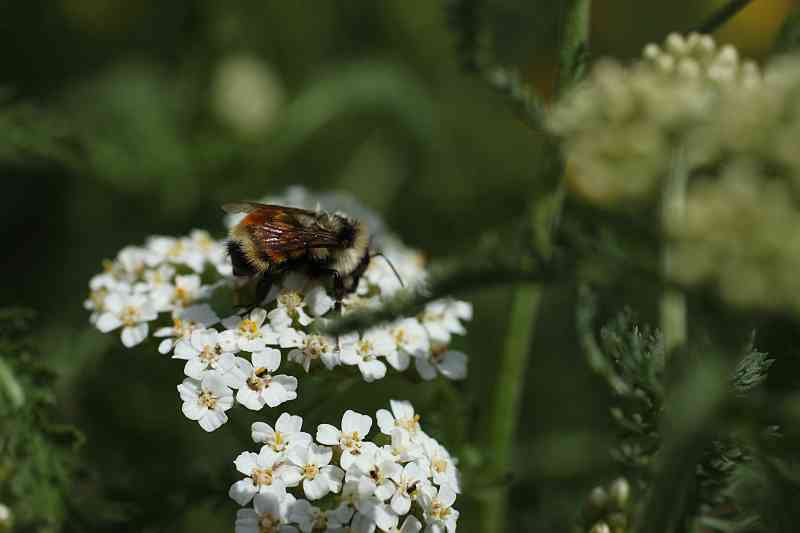
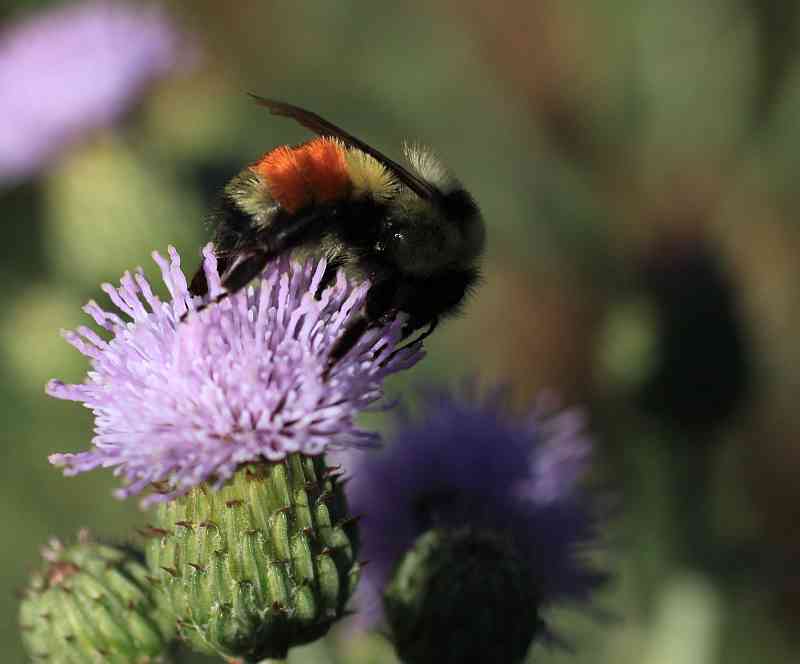
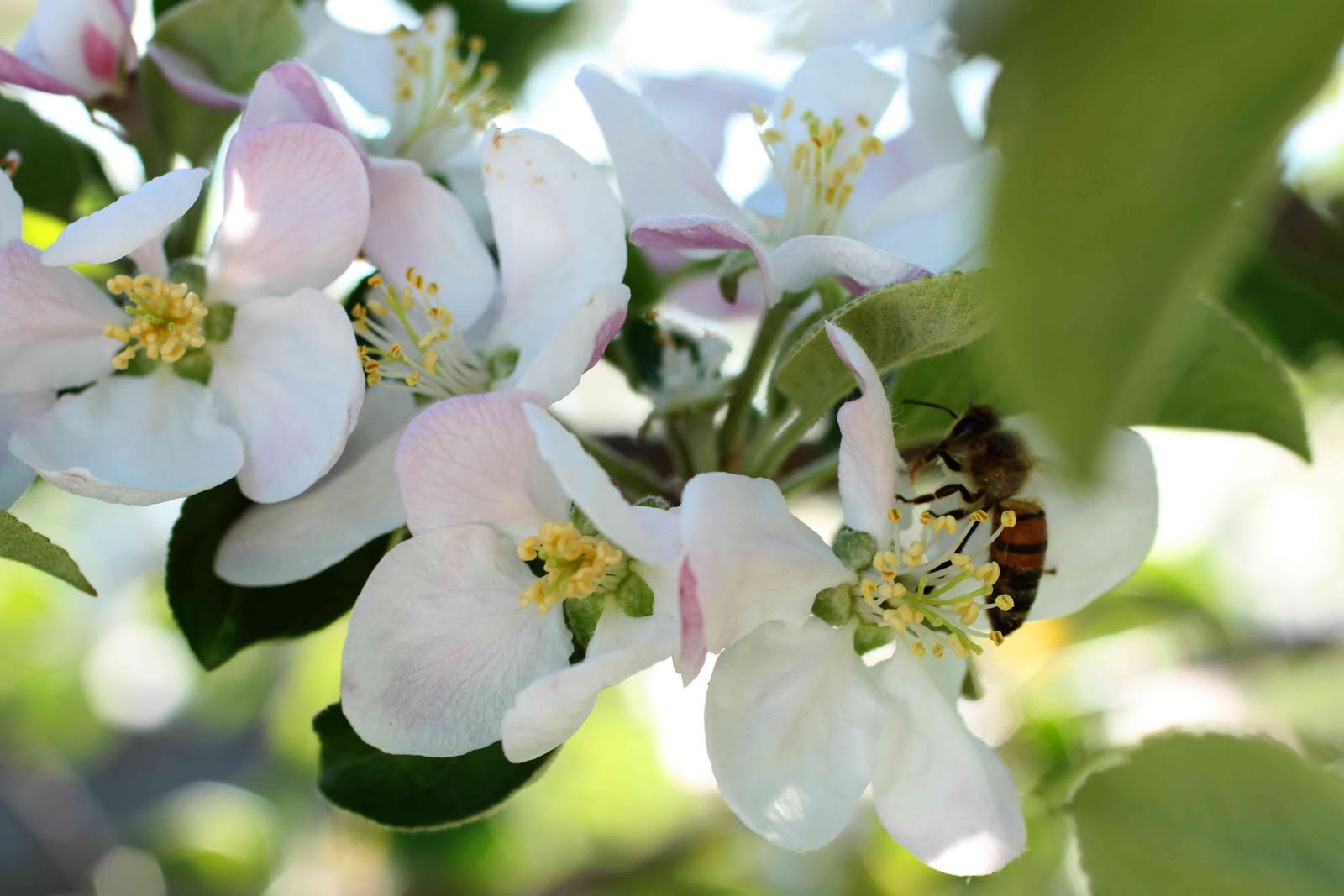
The same result happens with bees. I want you to scroll back up and take a good look at this bee collecting pollen on a dandelion blossom.

And this one on the onion blossom.
And this one on the thistle. Note the dark color or light as it may be, along with the width of the black bands. These bees are not all from the same hive but they could be. The one on the dandelion blossom and the one on the onion blossom are. I just needed some good photos to prove my point so I threw in the thistle one too.

This means that some bees in a hive are full siblings and some are half sisters having the same mom but different dads. The same can be said for the drones, only they would be brothers.

The differing fathers add strength to the hive by their genetic differences. One lending genes for superior endurance, another the canny ability to find pollen in a hurry, etc. 

So there you have it the bee part of the birds and the bees story.

Tuesday, June 7, 2011

Awe, The Sweet Taste Of Nectar

I have so... enjoyed having the hives in the yard and learning what flowers the bees are attracted to and what ones they avoid. No, not all blossoms are equal and most on the prarie I find they don't bother with. They must be poor sources of pollen and nectar.

The bees fascinate me so much that it is not uncommon to find me sitting within a couple feet from the entrance just watching or flitting around the yard  calling, "Wait for me." as with camera in hand I listen for their hum so I can zero in on the activity and contort this way and that trying to take a quick shot before they are dashing off once more to a different flower or back to the hive with their load of pollen or nectar.

But alas, it is nearing time to take them to the country for a different cuisine. They've nearly finished pollinating the plum trees, the apples trees, and even well, I must admit my abundance crop of dandelions. Sh... don't tell my neighbor. He's the dandelion police of sorts, always spraying his lawn weed by weed to keep them at bay. And here I've got a big patch I'm letting populate for the bees. I've got to admit after doing a fair share of research on dandelions, I've come to realize why the pioneers brought them to this country. They are probably the most nutritious plant in your garden. But I will soon have to get them under control or we'll be the bain of the neighborhood.

 There are only a few in the front yard and so my neighbors haven't been seeing what I'm up to. So I'm counting on you to keep a secret. Sh... don't tell them about the big patch hidden by the vetetable garden fence where they profusely bloom and they brighten my day. You do know that what separates a plant from a weed is that a weed is under appreciate and not wanted. Case in point, certain dandelions are grown for culunary cuisine. No, really they are but now I'm off the track. We were talking about bees. And my main reason for allowing the population explosion of dandelions by my vegetable garden is they of course bloom all summer and have kept the bees happy the past two years before their trips to the country, which is very very important. Ask anyone like myself who's been stung fifty times at once when she's made them VERY angry. Besides, those dandelions have been the source for the photographing I've been doing for an article I want to write. Oh how I'd love to start writing again on beyond this blog.

But there I go again, off track. You can see my mind flits about as bad as a bee after nectar. To give you an idea how profuse they have been growing, look at this new wax. This is from dandelion honey. The bees after they're born learned to clean the hive and then graduate to making wax from honey. At the time this wax was made, what was available was dandelion honey and so we have dandelion wax. It is so... beautiful and sunny yellow. I LOVE it for wax is usually a dull yellow.

Monday, March 7, 2011

Nope, Not Spring Yet

What am I thinking using this picture as a heading? Well, in your neck of the woods you might be enjoying spring weather and your crocus and tulips may be peeking out of the ground. Some of you may even be planting or harvesting from the garden but here, its our typical March / April weather, snow, snow, snow and then it snows again. So no... the heading picture of the snowmen our grand daughter built Saturday is not out of place.


In fact, this is what the ground looked like Saturday when she first built the mother daughter pair. Cold seeped in and snow began to fall again on Sunday. As I write, we are at 24.5F but we are to dip down to 4 tonight. Winter begins to wrestle this time of year. The weather becomes a tug a war shifting dramatically. December, January, and February are pretty barren as it's just too cold for much moisture to fall and so our worst storms are in March and April. It doesn't mean spring hasn't sprung in my heart or inside for that matter. I know I'm rushing the spring season, having started a couple pots of Siberia tomatoes. I only used a few seeds but I swear everyone I planted sprouted. The packages are getting old and so I'd ordered new tomato packet just in case. I did only two pots to test the waters and yes, it is really early yet to be starting indoors.


But after today's mishap with one of the pots of tomatoes and the one and only pot of parsley, I'm thinking planting extra is a good idea. Yup, our two year old decided to try gardening on her own. I'd do everything in the basement but I know I'll run out of room for all the things I want to start. I need to garden seriously this year since the basement isn't as full of food as it use to be. So I'm going to attempt to train her to leave them alone. Wish me luck. If you've any great ideas on how to keep a two year old explorer out of garden pots, let me know.
I've also a couple planters of lettuce going as part of an experiment project, finding someplace in my house that it will grow well. I've tried in the basement twice and that didn't work. I'm suspecting they aren't going to like it here either for the same reason, too warm. Look how spindly they are. Next, I'm going to try some in the living room. I'm determined to learn to grown tomatoes and lettuce through the winter in this house. With gas prices climbing at an alarming rate, it looks like I'll need to. I can't afford to run to the next town over for supplies very often. That means I'll run out of fresh things like lettuce and tomatoes that don't last very long. Sure, we have a grocery store but it is very small and the produce section is not what one would like. Not what they'd like either as they often aren't shipped the nicest stuff because their orders are so small. So I'll learn to be a bit MORE -pant, pant- self-sufficient. How did the pioneers ever get it all done? Oh yeah, they did without. That may just have to happen too if things keep escalating in Libya, North Africa and a cazillion other countries. Not to mention the natural disasters and crop failures that have the world in a turmoil. Yes, good and plenty may be a thing of the past. Think America will ever learn that being self-sufficient is a good idea?
.................................On the bright side..........................

During a couple days of warmth, in the forties. The bees came out in numbers. I was thrilled to see that both hives were alive. They sounded like both queens had made it too. How I hope so for I've not ordered any new ones.

They did the usual, pooped all over everywhere, all over the hive and the white wall of the shed the hives are resting against. Looked pretty gross. Isn't it nice that I shared? LOL Can't really blame them as they've not indoor plumbing and what do you do when you've been pretty inactive and all at once started running around in the cold weather? Yep, the same thing.


I watered them by filling a dish just outside their hives, wished them well, and told them I'd come inside and visit when the temperatures reached the fifties. Any lower and you can chill them too much and kill off your bees. I've got to check soon to make sure they have enough food to make it until the blossoms start. That's not for months yet. They should be okay as a cold winter equate to less food demand. They aren't as active and hence don't get around to eating much. That means warm winters are hard on honey stores.


Oh, they won't like my visit at all, and they are sure to think I'm there to rob them but I'll just take a quick peek into the top two boxes , then leave them alone if they've plenty of food. That is unless it warms up a bunch and they start robbing the pantry often. Spring is the time you loose lots of hives to starvation if you aren't careful.

If a hive is dead, you can suspect starvation if cell after cell has a dead bee with his head stuck inside. There often is still a LITTLE bit of honey inside. Don't ask me why they die before the very last drop is gone. I don't know. And frankly you should be proud of me because I'm going to go and make a cake and not spend an hour trying to find the answer on the Internet. LOL

Tuesday, August 17, 2010

Your Next Bee Lesson

Since I'd taken off the two boxes of honey and the bees didn't have lots left, I thought I'd better check the hive I'd robbed. What I found was that the bees had increased the amount of honey in the hive so I felt pretty confident they would be fine for a little while unsupervised.So I hung up my veil and gloves and stood in front of the hive within a couple feet and started to photograph. See how dedicated I am to you. Oh I tried to first take pictures with my veil and gloves on but the camera became sticky and I couldn't see what I was doing.And I didn't want you too miss an opportunity to learn. You were progressing along so well on your bee lessons that we just can't stop now. Get ready, this is quiz time. Can you find the drone in this picture?
Let me help you. This picture does not have a drone in it. Now study it carefully. Note the bee bringing in nectar. That means there is brood but the queen isn't laying too many this late in the year as the food supply is dwindling with the countryside turning a crispy yellow.

Now this photo has a drone in it. Did you find him. He's the one with the fat butt. Now isn't that nice for a change. I swear mine just keeps getting bigger and my husband's smaller. Yup, he's the one in the bottom of the picture that is dark. Now this bee is sipping honey that broke off from a frame that I lifted out to check for how much brood was being laid. The bees will collect all this and put it back into the hive.Don't want to tax the brain too much as I know all of you are probably working like crazy trying to haul in and can the harvest, unless of course you are in Australia and your opposite to us, and so that's the only question for today but I have a interesting fact. Okay, maybe not a fact but I'd say that cutter bees are better at pollinating alfalfa because they aren't as smart. You may argue with me on that but I can read through the lines of research. Oh, the scientist didn't come out and say it but what else is one to suppose when they say that honey bees learn that alfalfa snaps them a good blow and they aren't real anxious to go back and collect pollen or nectar?
Cutter bees just keep coming back. I'd say it was smarts but then I'm rather partial to a bee that gives me honey. They got to be smarter don't they storing up for winter like they do?

How that snap happens is that when the bee visits the alfalfa flower, it dislodges the sexual column causing it to snap. Here is where the observers argue. Some say the bee gets bopped on the head and others on the underside. I don't know about you but I'd rather be thumped on the back than the head. But either way, I'd be a bit leery about a repeat performance too. Yet, since my bees have little else to collect food from, that is what happens to them. When I found out this I almost felt sorry for them but then I had another slice of bread with alfalfa honey on it and my guilt feelings just melted away.


The researchers said honeybees aren't as effective as some others at pollinating alfalfa because they learn how to outsmart the plant and keep it from triggering the snap. See, I told you they were smarter.

Can't remember if I told you this or not but the reason we started with bees was because eating local honey eases your pollen allergies. Our young son had terrible sweet clover allergies and so we put in a few hives near a large sweet clover patch and after years of eating alfalfa and sweet clover honey, he doesn't have a problem with the allergy anymore. Of course by then Kirk and I were hooked on honey and though Kirk has encouraged me to quit because of my having too many projects, I refuse. I enjoy them and oh how good that honey tastes. It is especially sweet since we've had so many years of drought that we have been surviving on our stores from eight or better years ago.

As good as jelly is, we still prefer honey on our bread.


This is your second lesson. Note how dark the bee is flying with yellow pollen baskets on her legs. Then notice how light some of the other bees are. Yup, just like a cat, a queen bee mates with more than one male. Though each often chooses multiple partners during their heat cycles for lack of a better word for bees urges. With a queen bee, it is during her maiden flight and then she is bred for life. Call it a one day fling but it is a doozy for she then spends the rest of her life having babies.

So now when you see a hive with a stark contrast in the look of the bees, you'll know it is half sisters that your looking at. Then again if it is a brand new hive the bee keeper robs bees from other hives and places them with the new queen. Given time those bees will die out and the young queen's offspring will take over the hive. With this hive the answer to the differences in looks of the sister's is that the queen when young just couldn't resist tall, dark and handsome, and the lovely fair haired boy either.