Showing posts with label food. Show all posts

Wednesday, July 12, 2017

Experiment With Egyptian Onions

When a Colorado friend said that I needed Egyptian Onions. I didn't have a clue what she was talking about. But since her goals are essentially the same as mine, she had my interest. Especially since I've failed miserably a number of times trying to start onions from seeds. Oh I can grow the seeds really well and collect them just fine but all the plants that come up are super spindly. I don't know what I'm doing wrong but I've done it four times now. I figure if you are going to make a mistake at least you could make a different one each time so you can learn but  yet make progress. I'm still stuck at ground zero.  That is what made this onion that keeps going on its own sound almost too good to be true. When a friend of my husband, who adores my peanut butter cookies, said he had some and offered a few plants. I figured a trade was in order. His parting words of, "Be careful or they will take over the garden." left me a bit nervous but not detoured. Was this like Spearmint?
 
Rest assured they are not and I've decided I want more, and more, and more of these. They really are yummy! A bit strange since they clone themselves forming multiple onion sets on the top instead of seeds but strange can be good. When the sets are too heavy to hold up, the stalk bends over allowing the new plants to touch the soil and form roots. Thus one plant becomes many more and from this propagation method comes the name walking onion. The top set of tiny onion plants gives this plant the name Top Onion and for others they may know it as Winter Onion because it is good from zone 3, which is us, to those in zone 6 where you can pick this hardy onion all year. I've read that there are differing types of these onions but then not all relatives look alike so I'm not surprised. They do all have the strange propagation method.

 With so few plants, I did not cook with any of the onions until this year mainly due to confusion on the subject. I saw lots of recipes for pickling of the little onion sets on top and learned that you pick them when they are at least a half inch in size. But seriously people, I'm not growing these things for a few tiny little onions on top so I kept researching. Meanwhile, I removed the sets off of the tops of a couple plants like you would the flower bulbs that begin to form on traditional onions. 

As I suspected, the energy in the plant went to the bulbs instead of onion top sets. In fact, they gave up growing top sets of onions all together and the bulb increased in size. Now were talking something I can really use.

How big they will get I'm not sure. Like a kid with a pocket full of candy, I had to sample. Everyone on the Internet I listened to said the onion is a bit zesty. I did not taste that. Maybe it is because we live in zone 3 and heat has a tendency to make things hotter in flavor but these onions just tasted like... onion. Maybe a hair, and only a baby hair stronger but to this onion aholic, it was yum dilly ishush. I cut up a couple bulbs and cooked part of them with potatoes. There is nothing like fried potatoes and onions. They are soul mates.

Now I'm thinking why oh why did I not clip the tops of more of the onions while the sets were just beginning to form? I think I'll pretend it is so I'll have lots and lots of Egyptians Onions to do it to next year and you can bet I will. 


As for the rest of you, you can pick the top sets if you like to pickle but it takes a whole heaping lot to amount to anything, so for me, I'm going for the bottoms. If you are harvesting enough bottoms, you can be sure these onions are not going to take over the garden and how could you not. They are too yummy to let walk away.

While I was eating the bottoms, I tasted the top sets too. One has to compare and after all it is what everyone is talking about. Very mild in flavor like I suspicioned - similar to traditional onion stalks. For me that is what this onion is missing. Good tender stalks. The mature stalks are rather tough and woody. They say you can use these onions in the early spring like bunching onions and the stalks at that stage are tender but alas, I did not. Seems to be alot of that this year.  Maybe next year I'll feel I have enough to use these as spring onions. They should be ready just about the time my stored onions run out or the last few are getting soft. How perfect is that? Thank you dear friend. These are indeed a must have for my garden. 

Friday, March 17, 2017

What Plastics Are Safe?


 I was visiting with my daughter-in-law and she commented that she had changed out all of her drink containers to BPA free ones and felt her family was much safer now. I had just recently done some research into BPA and plastics and had some bad news for her.  I want to share with you, my friends what I found since plastics have come to the forefront of my mind recently. Our daughter was diagnoses with two cases of breast cancer and they are further investigating to see whether she has cancer elsewhere also. Her cancers are estrogen and progesterone fed and a source of imitation hormones is plastics.

 "We know that, "BPA causes hormone disruption, reproduction harm, increased risk of certain cancers, malformation of organs in children, risk of miscarriage, sperm defects, and increased risk of mental disabilities in babies. 93% of 2517 urine samples from people older than six years old showed detectable levels of BPA." A survey conducted by the Centers for Disease Control  

The research is conclusive in the area of BPA and simply put, it is toxic. But what most don't know is that most companies have replaced BPA with BPS, which is just another bisphenol.

{In the case of BPS, there's reason to believe it is just as dangerous to human health, and possibly more so, than BPA, although the research is not nearly as abundant just yet. Writing in the journal Toxicology In Vitro, researchers stated:ii
"In 2011, the European Commission has restricted the use of Bisphenol A in plastic infant feeding bottles. In a response to this restriction, Bisphenol S is now often used as a component of plastic substitutes for the production of babybottles. One of the major concerns leading to the restriction of Bisphenol A was its weak estrogenic activity. By using two highly standardised transactivation assays, we could demonstrate that the estrogenic activity of Bisphenol A and Bisphenol S is of a comparable potency."
Not only does BPS appear to have similar hormone-mimicking characteristics to BPA, but research suggests it is actually significantly less biodegradable, and more heat-stable and photo-resistant, than BPA. GreenMedInfo reports:
"... while regulators wait for manufacturers who promote their products with "BPA-Free!" stickers at the same moment that they infuse them with BPS to voluntarily reformulate,there isevidence now that BPS may actually have worse effects to environmental and human health, alike..
"... BPS' relative inability to biodegrade indicates: 1) once it is absorbed into the human body, it may accumulate there for longer periods of time. 2) it is more likely to persist in the environment, making external exposures to it, and its many metabolites, much more likely than the faster degrading BPA. In other words, its potential to do harm will worsen along the axis of time, not lessen, which is a common argument made for the purported "safety" of BPA."}http://articles.mercola.com/sites/articles/archive/2012/06/20/bpa-free-plastic-still-toxic.aspx}
So what we have here is a switcheroo. One bad guy in exchange for another bad guy probably worse than the first. The whole BPA free campaign has millions of Americans making the switch but are we are no safer than before. Disturbing isn't it?


So once again here is an example of where we have to protect ourselves because no one else is going to do it. But how? How does one tell for sure if they have a BPA containing plastic?
This is what Mayo's says:


{A resin code of 7 appearing on plastic containers indicates that the container may be made of a BPA-containing plastic.  It is a rounded triangle with a seven inside.
Some exploratory scientific studies have appeared in the public literature that have raised questions about the safety of ingesting the low levels of BPA that can migrate into food from food contact materials. To address these questions the National Toxicology Program, partnering with FDA’s NCTR, is carrying out in-depth studies to answer key questions and clarify uncertainties about BPA

The testing showed that more than 70 percent of the products released chemicals that acted like estrogen. And that was before they exposed the stuff to real-world conditions: simulated sunlight, dishwashing and microwaving, Bittner says.  Then, you greatly increase the probability that you're going to get chemicals having estrogenic activity released," he says, adding that more than 95 percent
of the products tested positive after undergoing this sort of stress.The team concentrated on BPA-free baby bottles and water bottles, Bittner says, "and all of them released chemicals having estrogenic activity." Sometimes the BPA-free products had even more activity than products known to contain BPA.
"We've long cautioned consumers to avoid extreme heat and cooling for plastics, to discard scratched and worn plastics and we feel like this [study] validates one of our many concerns," she says.}
http://www.mayoclinic.org/healthy-lifestyle/nutrition-and-healthy-eating/expert-answers/bpa/faq-20058331


#5 Rubbermaid storage containers. Love these as the lids fit multiple sizes and they stack so nicely. I found the idea of Pinterest to use a tension rod to hold things in place in a drawer. LOVE IT!!

Here is a hint to whether a plastic may contain BPA. Hard plastic containers have a triangle with a number inside. If it is #3 or #7, it probably is made with BPA. Remember that heat, sunlight, or very cold temperatures causes greater release of BPA's in plastic so don't freeze or put plastics in the dishwasher.

The Green Guide, owned by The National Geographic Society devoted to greener living recommends plastics with the numbers #2, #4, and #5. I've just started checking in my own kitchen to see what numbers are lurking in my cupboards.

Another bad guy is Styrofoam.

This is what Green Guide has to say about it:
{Containers made of polystyrene (PS, or plastic #6, also known as Styrofoam) can also be dangerous, as its base component, styrene, has been associated with skin, eye and respiratory irritation, depression, fatigue, compromised kidney function, and central nervous system damage. Take-out restaurant orders often come in polystyrene containers, which also should be emptied into safer containers once you get them home.}

Once again a tension rod used to hold things in place. This idea is especially nice with drink containers.
There is no way to eliminate plastics from our society and why should we? I think a more sensible approach is to limit where and how we use them. The next blog talks a bit more about this and I will show you another place where food manufacturers are hiding BPA. But meanwhile tell me, how many of you were surprised by this information? I sure was.


Thursday, December 8, 2016

To Ghee Once Again

It has been a few years since I made ghee. Time is so constrained with so much to do. I am trying to figure out ways to save on our grocery bill and I do have lots of cream. I have made ghee each week from freshly made butter but now I can see the next batch will come from the freezer. I was wise and froze quite a bit. The goats are quickly drying up as the low temperatures drain their bodies. Calories are being spent on keeping warm, not producing milk especially since they are pregnant.

The plan is to have enough separated milk to keep buttermilk, and yogurt going. I usually use whole milk but not during this time of year. I will use separated milk and hopefully have enough to drink also since we don't drink much milk. I  put away some canned milk for cooking earlier this fall and hopefully that will help ease the need for frozen milk. The cream I froze will become sour cream of which I have not started culturing. It will probably have to wait until Christmas gifts are done. I also will make ghee and cook with cream. It will be interesting to see if I have frozen enough. What would have been better is if I had already made my ghee and canned it as I wish to eliminate one of the three chest freezers we have. I also want to play with making cultured butter. The butter I make now is not as flavorful as I like so I buy less expensive butter to cook with and Amish cultured butter to eat.

Someday I hope to be making all my own butter and ice cream but energy, time and enough cream is a problem.  Problem is winter is when I have the time to do the most things with our milk and it is at its lowest supply. I could make lots of butter and pack it away in the freezer. I could make lots of ghee and can it for the rest of the year in the winter IF there was more milk. 

 It is impossible to do everything all year long. Winter I could also try my hand at cheese and freeze some. Maybe dear little Ellie can fill that winter void. I hope to calve her in September of 2018 allowing her to raise her calf for five months. She would produce more milk than the calf needs so the extra would supply us with milk during the winter along with the plethora of things that it can be made into. I know how to make Feta and mozzarella, and want to start making Monterey Jack. The last being a cow's milk cheese. I would continue to milk the goats fall and into December and hopefully this would help create that freezer surplus along with milk from Ellie.

One of winters tasks this year will be trying to figure out when different tasks can be done and how to push others into a season when the tasks can more easily be done  because things are just a hair bit slower.We need a cellar I can see to help with the vegetable side of this.

Ghee lately has been substituted for most of the olive oil we once used. That is definitely saving us some money. Ghee is now what we fry with since it has a higher smoke point. It is what I use in bread making too. It is not the best in pie crusts and cookies - rather greasy. It would be good if it was except I would never be able to keep up making the stuff because unfortunately we love our sweets. We want to use ghee because it is even more nutritious than olive oil. We don't use it because it is cheap. It is only less expensive for us because the base (whole as in cream and all milk) is something we already have.
The children who dislike the smell of it cooking don't dislike the taste. Some of the children think it smells like buttered popcorn, others think it stinks.

What I learned is that ghee comes at a price. These two half pint jars that I figure is equal to a wide mouth pint jar is what is left after cream is separated from over two gallons of milk. I get about three quarts of heavy cream from 2 gallons of milk this time of year. This cream is then made into butter. The butter is then cooked down removing the dairy part. The dairy forms a clump on the top of the oil and sticks to the bottom of the saucepan.What remains is this pint of ghee. I saw one person feeds the butter cast off to her dog. I think I will start feeding it to our barn cats. An area I am working on saving money too is buying less cat food.

If you wonder why ghee is so expensive at the store. Over two gallons of milk down to just one pint is the reason. The health benefits make it worth the effort but I don't recommend that you go to the store and buy organic butter to make ghee from except as an experiment to learn how. I have been going through about a pint and a half a week - pricey indeed. But this is all a part of self-sufficiency. What I have not done yet is use this oil for light. Yes, that is possible. Ghee is indeed nutritious and versatile.


Thursday, April 7, 2016

My Tomato Plant Experiment Just Became Bigger


I went to see our oldest daughter. Unbeknownst, I seem to have included her into one of my experiments. One of my tomatoes grown from seed needed a home. Our oldest grows a few vegetables in pots wherever she happens to be renting. This time she has a lovely enclosed back porch that has two big windows flooding the place with warm sunlight. Her lemon tree is there and I figured it needed a companion.
That tomato plant has grown like crazy. I swear the thing has doubled in size in one week and not just up but out. She thinks she can actually tell a difference each day. It is gorgeous. I was feeling rather guilty as none of mine look that good or big. Then reality set in. There is no way I have room for pots that large let alone eleven of them for just the tomatoes. A closer inspection of the lush plant revealed that it had only three blossom clusters in the earliest stage of development. Is all the energy going toward the plant and not fruit? When I gave it to her it was one of the smaller tomato plants. Question - will the larger, healthier plant of our daughter's produce more fruit in its lifetime compared to my own smaller plants? Even if it does, I do not have room for such a large pot let alone eleven such pots. I have a few round pots and I think I will try and use a few on the porch but round does not fit in as small a space as square or oblong. With trying to grow plants in the house to eat and a number of plants started for the outdoor garden space is a big problem. It is why I do not recycle pots such as cottage cheese containers and vegetable cans.


With her inspiration I took three tomato plants started from seed in a big pot and set it in front of the side window by the front door.  I put them wa....y down in the pot to bury more of the stem so as to grow more roots and give the plant more support. The tomato plants from seed get tall and bend over especially when loaded with fruit. To only allow it to grow more roots but give them more support. The plants are suppose to get only 12 inches tall but mine from seed are more like 20 inches or they were last year. Right now we are at 15 inches.


The plant on the left is smaller I  allowed the blossoms to develop earlier than the plant on the right. At this stage the plant on the left has more tomatoes. Will the one on the left end up producing more tomatoes or the larger plant on the right? I definitely won't have a problem with the plant on the left breaking because it is too tall. Right now it has over 40 blossoms or tomatoes on it. Some on the window side are turning red. Not bad when you think I started this plant the beginning of January. Definitely faster than tomato plants grown and set outdoors. The cloned tomatoes having a few more blossom clusters per plant than the tomatoes started from seed.

 
So really I have three experiments going now. Cloned versus started from seed, allowing blossoms to form earlier or later, and small pots versus large. I may end up deciding that a combination is best . That way the develop of tomatoes will be extended over a longer period of time.
 
Part of this experiment is how many tomato plants it will take to keep us supplied with tomatoes. Not sure it can be accomplished as how can one get enough of summertime fresh flavored tomatoes? 

 This is this years experiment but next year it might be too cold a winter to grow the tomatoes in the window and they will have to go under grow lights. Then I will switch to cold hardy lettuces in the pots in the windows. I started removing more BIG rocks from the front flower bed. It was truly a ROCK garden. Not much room for much else to grow. In will go a long box to transform into a cold frame. It was a box a heavy piece of equipment came in. I'm always looking around to recycle. One of those recycle projects is bent T-posts that will be changed and used in the garden. Another one is using feed sacks to make tarps for the garden. Things are truly a hopping.


Thursday, February 11, 2016

New Lessons Learned About Yogurt and Buttermilk

A little reminder, using a dry erase marker on your glass jars helps you remember the date the milk was taken. This way I know which milk to use first and which to give to the chickens. The oldest of course. Feeding milk to the chickens saves financially as I do not have to buy as much oyster shell to increase their calcium levels. Egg shells are mainly calcium and we like hard egg shells. If I have an abundance of old milk then the garden gets fertilized with it.

I also label my buttermilk cultures and yogurt with the date cultured since they are in glass jars. When you do something like this week after week the brain gets muddled or mine does as to the exact day you did it last. Of course if you had a nice calm life you could do it on the same day of the week. What would that be like? 

Yogurt and buttermilk I've done quite well keeping going. Not perfect but pretty good. In doing so I have learned heaps. My yogurt quality has increased. One gal asked me when I first blogged about it if our goat yogurt turned out slimy like hers. She had quit making it. Ours was indeed a bit slimy but I've learned the solution to that problem and it wasn't through research. It was experimentation and time. I have learned that you need to warm your milk very slowly. I put my electric stove, I wish I had gas, on 2 and the milk takes nearly an hour to come up to the 180 F it has to reach. The length of time it takes depends on how much milk you are heating at one time. Then I either cool the milk quickly or slowly according to whatever is happening around here at the moment and when it reaches the proper temp, I add the culture.

I usually make yogurt and buttermilk at the same time, something new from the first blog post on the subject.  One pot holds all the milk. I pour a quart worth of the heated milk into a sterilized quart jar to cool as the buttermilk needs to be 85. The rest of the milk I let cool in the pan to 115 before adding the yogurt culture, mixing it in, and putting it in the yogurt maker jars.

The buttermilk jar when cooled to temp., I wrap with an old heating pad that does not have an automatic turn off switch. Mine is set on medium. I can do two quarts if I plan on making lots of recipes that week with buttermilk. My family LOVES homemade buttermilk pancakes and biscuits.

The texture of the goat yogurt done this way is smooth and creamy. Time spent culturing varies with the particular milk I'm using. This varies as to the period of time we are in the goat's lactation as the cream level changes. And what the goat's diet is also makes a difference. Right now they are getting orchard grass hay but later it will be a orchard grass alfalfa mix for later in their pregnancy.

 Sometimes it takes longer to reach the desired thickness and sometimes shorter. Keep in mind that store yogurt has gelatin or powdered milk to thicken it but I can do it pretty well with fiddling with incubation times. Greek yogurt is thicker because of the additives or some strain the liquids off of the yogurt to desired thickness.  Right now the cream level is really high at about 1/3, which seems to equate to a thicker yogurt. I sometimes make yogurt with milk that has run through the separator and then the cream runs through again once more which gives a heavy cream.  The lighter cream run off is then mixed back into the milk. 

Did you know that 2 percent milk sold in the USA is only one and a half percent less fat than whole milk? Yes, it was a great sell campaign that made it popular - not the facts. Buy whole milk and add water if you want 2 percent. You are just buying more water with 2 percent anyway. Better yet get a milk goat. 

I can use yogurt instead of buttermilk in many of my recipes and often do. Depends on how many fruit smoothies or buttermilk pancakes were made whether I have more buttermilk or yogurt in the refrigerator.

The other thing I have not done is to freeze buttermilk and yogurt. The learning just never ends. This is handy when the goats are dry as you just freeze milk and then culture once a month to keep things in reserve. Or better yet if you have the freezer room you just keep thawing milk and culturing.

The other thing I want to try is on this site where you use a powdered milk to mix with a culture and it keeps for a year in the freezer. This is often used to ensure a pure culture. http://www.leeners.com/yogurt/how-to/yogurt-culture.shtml
Things to learn just never ends. The problem comes in on how to keep everything going not just trying it once.

Sunday, October 25, 2015

Potatoes and Other Things


This has nothing to do with today's subject but let me introduce you to our newest member of the menagerie, his name is Duke. With Kirk setting traps, our older cat spending long hours hunting, they just could not keep up with the influx of mice so Duke entered the scene. He is already catching mice at his tiny size. One day I watched him kill a mouse in the morning and another in the evening. Don't know how many he scores a day but it is impressive for so small a kitten. My advice would be if you want a cat to cuddle, go to the shelter; if you want a mouser, find a barn cat's kittens. They have the instincts to hunt or their parents would not have survived. Our cats of course have a back up of cat food to keep them healthy but I would not choose a shelter kitten for a barn cat job. They have the wrong resume. Duke is beyond spoiled as the grandkids seldom let his feet touch the ground. Good thing the three oldest are in school most of the day and there is just our three-year-old grand daughter left at home or the kitten would not get any work done.
***************************

Gardens are coming to a close here up north and ours for the most part came to a halt back on August 22 when we had a killing frost. Yes, even a bit early for here. I thought with all that I had learned the past 33 years gardening in our old home, same altitude, same growing zone, that the learning curve would mainly just be the change in soil. Boy was I ever wrong. Things that I could grow before like Brussel Sprouts just don't stand a chance up here. I even tried two different varieties. My first thought was they are a cool weather crop and hence should do pretty well up here? I've tried for two summers and they don't even come close to developing. Corn is another huge struggle and I have not gotten a crop in two years. I've not given up on it. I do love my corn and I have a few ideas to try. What I have learned from observation of the last couple summers is that we have far cooler nights and that halts growing until the temp raises in the morning. That means not only short season but cool season crops, really cool weather crops have to be found.

My sister has a kind of bean I am unfamiliar with that did well for her and she lives at a even higher altitude but I think their nights are warmer. She promised to send me some and said if I like them she will send more for seed. Like the taste I'm thinking is less important than if they will grow in a survival situation.  My dried bean experiments that has been going on for 6 years is taking a very different turn but I'll talk more about that later.

Short season, really cool weather crops will take priority and cold frames, tires, and row covers are going to have to be a big part of our plan. The greenhouse frame will have to go up next summer and since the tomatoes and peppers did well up against the house on the south side, we will work on a frame that can cover that area also. Anything that tempers the cool weather and holds warmth is going to be a biggy.
                                ******************************************
Since it is the time many will be digging their potatoes I thought I would update you on my experiments. I would not have my tators so early in September with the unusually warm weather we have had after the killing frost but when I dug up a few hills for eating, I discovered some rotten were rotten. I was shocked! My potatoes don't even rot when I hit them with a shovel while digging. They just scab over and remain firm. I'm blaming the ghostly pale, BIG fat worm lurking amongst my crop. Anyone know who it might be? He looked like a pretty shady character and I didn't like the look of him. The bites out of the potatoes were pretty good sized and I wasn't about to take a chance loosing the whole crop, so I dug.

At the encouragement of my sister, the same one with the beans, I tried Pontiacs since I LOVE red potatoes but they failed. I put Dakota's back in and they gave me a puny crop. They did better last year but not a terribly impressive show. The King George potatoes came through as they have through disease, drought, hail, and every other adversity. They even produced potatoes on plants that did not blossom last year. I never knew that was even possible. I get some pretty big ones too with quite a few per hill. More than anything else I've grown.
                                               Photo is of a King George Potato
I was thinking when I stabbed a few Dakotas, "Now these are going to turn to mush and I will have to put them in the mulch pile. There are too many of them to have for supper." Hmmm......" What shall I do to not waste them?" Here is where the brain fart enters in. "What if I took all the damaged potatoes and made potato flour from them?"  You know this brain never rests.  I hurried, washed them, boil the potato pieces, cut them up into smaller pieces, dried them in the dehydrator, put them through the blender to chop them up even littler, and I will put them through the wheat grinder when I get it out to grind wheat. The guilt of wasting food is gone and I am feeling pretty smart. Something I savor whenever possible. Especially since I have been doing some carpentry work lately and that always leaves me feeling and looking pretty dumb.

I have decided to halt my potato diversity plan for now and move on to my next experiment in the form of figuring out how to work with true potato seeds. Something the plants don't produce every year. Some of you don't even know what that is probably. I sure wondered what the clusters of green balls that produce where the blossoms were? That is them, true potato seeds. Potatoes that I had saved, put in the ground, saved some from that crop, and put in again produced the potato seeds. Not sure if that was what it takes or if the weather was just right but I plan to find out by keeping records. I've been wanting true potato seeds to begin my next experiments because of the  "What ifs?", which send surges of panic through me. "What if we were in a survival situation and my potato cropped failed? What would we put in the ground the next year to get a crop?" It isn't like you can keep tiny potatoes in storage for years. There were thousands who starved to death in Ireland from a potato famine. It could happen again as history repeats itself.

Don't know how long true potato seeds last but surely longer than small potatoes. I can see I have more research to do but now I can begin to learn for I have some seeds to grow into plants and begin the next phase of experimentation.

It is my understanding from research that it is the true potato seeds which harbor the genetic crosses that become new strains of potatoes. I'm not at the moment interested in producing a new kind of potato as I only have one kind that is doing well but I am hoping that the seeds remain viable for a few years giving me a back up safety system. First I have to plant them and see how long it takes to produce plants large enough to put in the garden. Well actually first I had to try to remove the seeds from the green firm balls. I'm hoping unlike peppers and cucumbers that there isn't a specific age development at which you have to do this. I just picked a few off of plants that were dying and a few more off the ground where they had fallen.

I followed directions that recommended you put the balls in the blender with water and chop them up. This left me with a mess, too much pulp per tiny seeds. Wondering how to separate this mess I put them in canning jars and waited to see which seeds floated, they are the bad ones, and which seeds fell to the bottom. The seeds just didn't want to fall because they were held up by all the pulp. I shook the jars now and then and tried skimming off pulp from the top. There were just too many seeds that ended up coming with each scoop and I felt wasteful. There has got to be a better way. If you know of it please share. I dried the seeds and pulp that I wasn't able to separate both ended up on parchment paper together and I figured the pulp will just rot away when I plant the seeds. That is plant them next spring under grow lights. Answers just don't come quickly when it involves gardening. It takes years to sometimes to find the answers and gain the skills needed.  It is one area I would gladly pay to be an apprentice to speed up the process. There are just so few that have the knowledge in my area
.
 Have any of you tried working with true potato seeds?


Wednesday, October 8, 2014

Potatoes

It snowed again the other day. The forecast for 22 F. sent me rushing to get my potatoes in. Some were eying the skies and with their heads poling up I wasn't sure they would survive the cold night. With the potatoes shivering in laundry baskets. Maybe shiver was a bit much but even if they weren't I was. The dried bean shells had ended up proceeding being pulled. I have such ADD at times. I started to dig the potatoes and the effort made me stop and look over at the dried bean rows. I thought they'd make a nice break so I went and started pulling plants while ripping off swelled pods and putting them into buckets. When my back grew tired of beans I started on the potatoes again. Which had me stopping once more to look over at the green bean plants which I had quit picking weeks ago with the fleeting hope that they would have time to form seed.

Maybe just maybe I could get a little of them but by then it had started to rain and I had to rush in the garage the potatoes and dried bean pods. When it started to hail I was done. The howling winds making them seem like the skies were hurtling BB's at me. I huddled in the garage on the tarp, my hood on my sweatshirt pulled up and occasionally glancing out the window at the rain/hail, thinking it would soon stop, I began shucking beans from the shells. Did you know that is addicting. I couldn't stop though the rain/hail turned to snow and I became colder and colder.  I did not stop until all the beans were shucked. Then I started a fire in the stove in the house roasting marshmallows of course. I do love a good golden brown marshmallow all crunchy on the outside and warm gooey on the inside.
 It wasn't until later that I got around to sorting potatoes. Once again I'm thrilled with my King Harry's. The best performing potato I've ever had. I know, I haven't had many but this one has far surpassed anything I've ever grown. In the old garden here. (Hmmm I really do need to name the gardens. Want to help?) I had wilting disease  but the King Harry's still produced medium to small potatoes. Shocker as the plants didn't even blossom. These were the potatoes I grew in the garden at the old house. They out performed that gardens harvest by many times. The soil there was horrible. Having grown them for a while I had forgotten that when you nick a potato it often turns to mush later. These don't.  
Some of the King Harry's were at a whopping 4 1/2 inches. The amount of potatoes each plant produces was once again impressive. These are my main crop potatoes and I just might start calling them Ole, Reliable. The only downer is that to my great disappointment they did not produce seed this year. Hopefully that will happen next year and I can figure out what prompts it. You know the commercial potato growers know the answer.  
My Norland red potatoes succumbed to the wilt disease, are a fussier potato, and I'm going to try something else next year. The new potato, the Norkotahs were a nice surprise. Some were monsters. This one was almost nine inches.
 This is one hill, so not too bad for production. They do turn to mush when you dig them with a shovel and slice one. I think I'll have to get a potato fork as I plan on raising these next year.
What tickled me was that a couple of the Norkotahs had artistic shapes. I remember as a child picking up potatoes and putting them in a gunny sack. This was at our cousins of which there were eight children. That meant an acre of potatoes or was it a half acres. I don't know but a lot. My uncle was a farmer and would dig the potatoes with the plow of the tractor and we kids would sack them. I'd ask him about those potato seeds but alas, he is gone. Oh the fun of working together and the delight of finding these mis-shappened potatoes. Maybe not so fun in the kitchen  as they are a bit difficult to peel but they sent a child's imaginations a racing. 
 
Though not the crop we had planned, we would have had potatoes coming out our ears, not literally of course but blessings none the less as more potatoes than we have ever had before.  BLESSINGS!!!

What is your favorite kind of potato for the north? I'm trying to find three kinds of most vegetables.

Friday, September 13, 2013

Corn Silk Tea

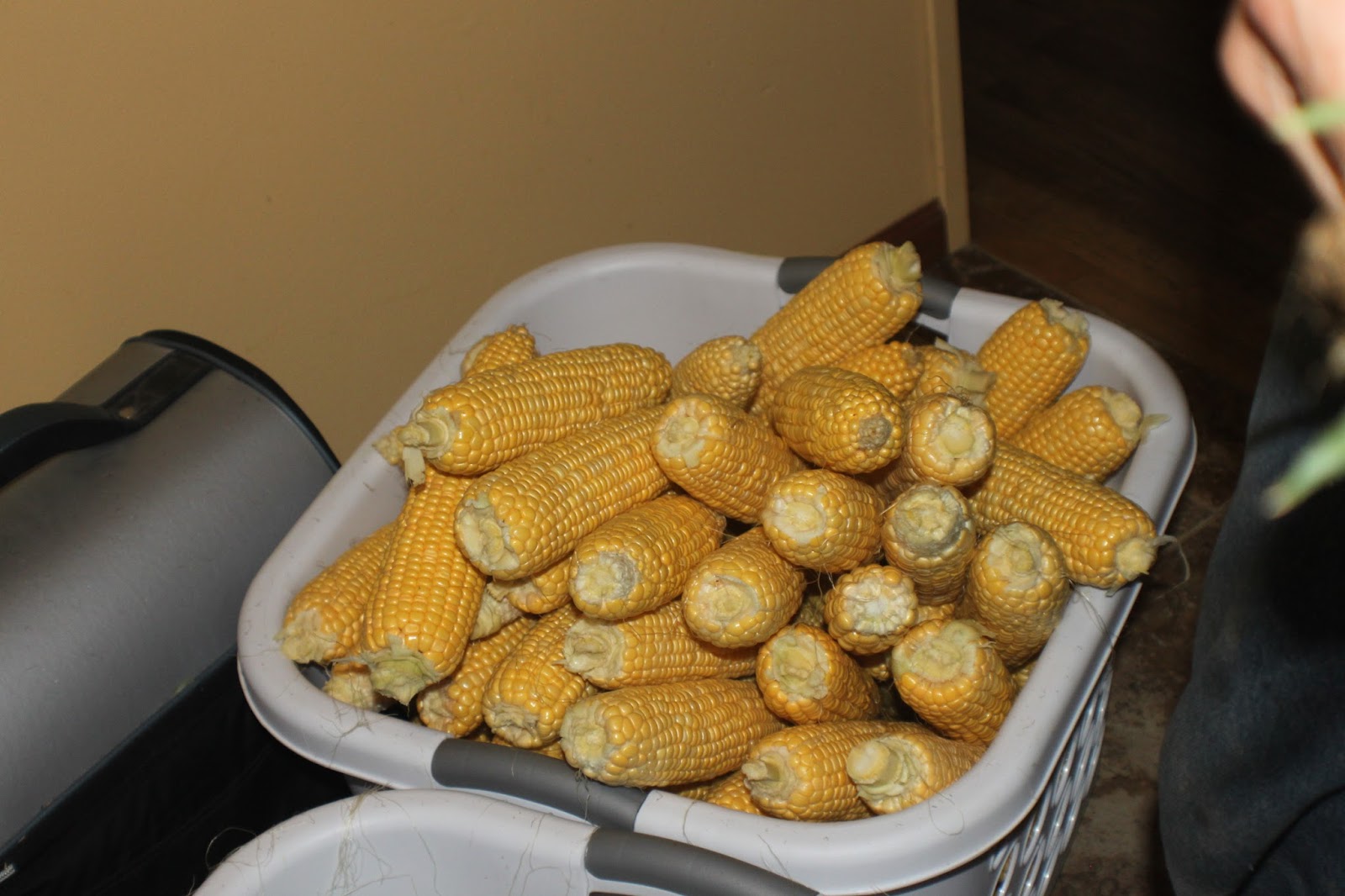
 Last week our oldest daughter showed up with the equivalent of six and a half of these square sized laundry baskets of corn on the cob. When she said she knew of a place where she could get free corn and did I want some, I said of course YES! I asked for six to ten dozen. She brought home more corn than I have ever done at one time in my entire life BY FAR.  Whoa did we ever freeze corn.  I was tucking it in every corner I could of freezer space until she took her cooler of corn home.

Explanation for such a load of corn, it was free and beyond that they picked until they felt inspired to stop. They'd come back to her vehicle and feel pressed to go out again so off they went until one time they felt they should stop. Probably in part because they ran out of room. LOL How could I argue with that explanation? I too have often felt prompted to do things I just didn't understand  at the time like can lots of peaches and pears though we only needed a few more jars. The reasoning is usually apparent the next year because the crop fails or money is tight. So I rolled up my sleeves, wondered what the reasons were without thinking too hard, and went to work.
 Luckily I had help, my daughter and some of the time my hubby. It meant we only had to stay up until two in the morning to finish. Finish the corn that is because we were too sleepy to finish the clean up. I cut the corn off the cob and then blanch it making the task far easier but it still seemed like the mound disappeared slowly. Then when we were about done I asked everyone to start saving the corn silks. It slowed things down considerably as you had to firmly grasped the silks and pulled the greenery away instead of the usual whisk of a couple pulls and the whole husk came off. Well, with me that is as I've done this a few cazillion times before.   
 What in the world was I thinking? Well I just happened to come across an article about the medicinal properties of corn silk.

Corn silk is used for
bladder infections, inflammation of the urinary system, inflammation of the prostate, kidney stones, and bedwetting. It is also used to treat congestive heart failure, diabetes, high blood pressure, fatigue, and high cholesterol levels.


Not that I was looking for any of that. Though a quick read and it became clear that corn silks are a good thing and one more natural  diuretic. What I was looking tooling around on the Internet was a natural source of vitamin C. I found out that corn silks are indeed high in Vitamin C and also K.Why the interest? In WWII Vitamin C was badly needed and so in England they dried rose hips and fed them to their children. I'm interested in self-sufficiency and Vitamin C is a biggy to have.

I've not tried the rose hips yet, the home-made ones that is, but it is on the to do list. The one that keeps getting longer no matter how many things I do. I have tried the store version of rose hips. Some will remember my experiment with pine needle tea as a source of vitamin C. Definitely a survival version as the taste is just like it smells -- not appealing. Not horrible but just rather sappy like.

 Dandelions are very high in C's and are also a diuretic. But then so are strawberries and lots of things. And now I've found out about corn silk so I'm thinking that more than one source of C's is definitely better especially since you don't know what the weather will bring. This year for instance it wiped out our garden. The pumpkins and other squash tried to come back but a month is definitely not enough time to do so before the threat of frost.

The high Vitamin K in corn silk might just come in real handy too as it helps to clot blood. Wonder if it would work as a poultice too? Hmmm....

With corn silks you do have to watch the amount. Too much of a diuretic isn't good. Too much corn silk and you could lower your sugar levels too low. Too much and you become dehydrated or your blood pressure becomes too low. As with all supplements we have to use our heads about them and remember that moderation is the key word. We also have to be aware of their interaction with the medications we are already taking.  

They recommend:
Corn Silk Tea Recipe: 2 tsps dried cornsilk to one cup boiling water. Let stand 10 minutes, strain and drink. Use only one cup per day for a maximum of 10 days.

My silks are dry and ready when I am.
Yet what excited me most about this project is that I can use more fully my corn. I'm not sure this corn she purchased is organic, probably not so I didn't save a lot of silk. But none the less it is worth trying a little in a few ways just to have the knowledge. Then when I have my own garden again I can save in a bigger way. We will have sweet corn and corn meal corn and the stalks can be eaten by the livestock. The corn by us either fresh, frozen, or dried. I don't like bottled. The corn silks can be dried and kept for medicinal needs. The cobs can be dried and burned for fuel. Now that is really using your harvest.
As for taste of corn silk -- I'm not sure yet. The Internet said it tastes like green corn. What part are they referring to because I thought if it was green then the corn kernels haven't developed yet so what are you eating? We will find out though one of these first days as I'm going to give corn silk tea a try. Got to be better than Blue Spruce needle tea doesn't it?

The other way they recommended using the silks was to put them in soups as a thickener. Now that sounds very doable as long as green corn flavor isn't repulsive. Hmmmmm...... don't know.Maybe best to go light on the amount at first.  

All I do know is that we haven't slowed down enough to get my head around using it. We've hauled hay twice this week which is a six hour trip twice. Hubby worked on the car replacing brakes, serpentine belt etc. while I cleaned up the house. Then yesterday we gutted the bathroom. We discovered a water leak. Not that there wasn't a hole in the floor already from a previous leak. We just hadn't gotten to the remodeling yet. So we began to tear as this appeared to be something new. The water was pooling by the toilet. Nope, not the toilet. Yup, the shower faucet valve once again but by then half the wall was tore out.

Oh well, in for a penny, in for a pound so we just gutted all the walls and removed the furnishings. We still have the floor and ceiling to go but it is a great start. We wanted to finish the front porch that day but the roofers called at 8 and said can we come in an hour and a half to do your roof. With shingles flying off we thought it best to remain indoors throwing sheet rock out the window into a wheelbarrow.

With houses galore to roof in town and a long list of customers we thought we'd better get it done while we could. There are 27 construction companies in town trying to repair the damage from the hail storm. Our population is only 1200.
  
I had big plans to go dump the bathroom garbage at the town dump 45 miles away north and shop for sheet rock and paint for the front porch the next day. Alas, yesterday morning I found a very sick yak at chore time. I'd not been doing yak chores for the last few days as we divided and conquered the livestock tasks. I attended the critters in the upper corrals milking and taking care of chickens. I barely even glanced at the yaks in the distance though I did ask if they were alright because I noticed Gracie laying down more than usual. The vet chewed me a bit and told me never to do this again. He said needed to take the full responsibility and have others help when needed. He was right. I have the gift and skill and it isn't fair to the animals to put it on others. 

Gracie baffled me. She had conflicting symptoms and I wasn't sure what we were dealing with except she was really sick. The matter was made worse since I was watching the little youngins that day. The one year old was in tow and a sick yak with big horns is not a place to have a one year old, especially since this yak hates kids. I called a couple friends to confer with leaving the tyke in the truck in her car seat. I then called the vet and his assistant relayed my information while he performed surgery. Then we loaded Gracie up in the trailer while my one year old looked on, shouting encouragement. Okay, she didn't shout encouragement.
She screamed in protest at being left in the truck locked in her car seat but what was I to do with her --safety first.

After picking up the four year old grand daughter from preschool at eleven we waited for their mom to arrive and then whoosh, off I went driving the hour and a half to the vets.

Heard the saying," Took everything but the kitchen sink."? Well I did take everything including the bathroom sink as my pickup had the toilet and all piled in back. Quite a site I'm sure but a girl has to do what a girl has to do. The dump was north and I was headed south.

Life has really been challenging the past couple years and especially this last summer. Yet despite all the challenges coming our way lately, I still stop each day and count my blessings. One can't be depressed and feel blessed at the same time. A friend I've known for years, though not a very close friend, committed suicide this week. I wish she would of counted her blessings each day. I've always found that the blessings out number the problems.  But it does take effort as blessings don't jump out at you like problems. So yesterday when I was feeling overwhelmed, I counted just a few of mine.  

 1. I had the help of two skilled livestock friends to load Gracie. They are often not available.
2. The trailer and pickup made it to the vets and back without a mishap. No flat tires and the truck started. It still isn't working right despite two new parts. At least one or two to go.
3. Wednesday we got the roof done.
4. The bathroom leak was a pain but at least we were planning on gutting the bathroom anyway and we've started. 
5. Gracie didn't need an IV after all like the vet thought from our phone conversation. It wasn't the terrible disease he feared and a big ole shot is all that was needed.
6. Since it is dust pneumonia it probably won't spread. Yes, dust can irritate the lungs and pneumonia will set in. We are really, really dry here with poor Colorado below us drowning.
7. Gracie's nose wasn't running and her fever appeared to come down last night. She was more bright eyed.  
8. I had money to pay the vet bill. It was part of the money I made selling the little whether goats. Not how I wanted to spend it but I had it none the less. Since Kirk is racking up the medical bills this is a biggy.

As I count my blessings I can see indeed, the Lord is mindful of me just as he is of every sparrow that falls. Though I have challenges a plenty, I'm never left to face them alone. I just have to look for the blessings to know of his love for me.

Sunday, September 8, 2013

Corn tortillas

BLACK-EYED PEAS - (or Cowpea) - A oval, creamy white bean with a black "eye." Soft textured.


Oh what or what shall I do with this bean - pea or whatever you wish to call them? Don't remember where I got them or how long I've had this bag of them but it is high time I used them up. That was my thoughts a few days ago when I put a batch of them in a crock pot. For years now I've just bottled beans and then used them. A real handy method but I'm almost completely out of canned beans. I've a few black beans and a few kidneys but that's it. The temperatures have been in the 90's F. Hardly canning weather. Mighty hot for September.  

I got to wondering, how come I've never crock potted beans before? I think it was the fear of it taking forever for them to cook. Now that was crazy. I just put the beans in the crock over night and ta da in the morning they were done. With half the beans I added the rest of the goodies to make ham and bean soup. The other half of the beans went in the refrigerator until today. The leftover ham for the beans was from another meal.

The other half of the beans in the crock pot I put in the refrigerator to make refried beans today. Half of the hamburger and onions I cooked to go in with the refried beans in a tortilla shell I put in the crock pot with stewed tomatoes, a small can of tomato sauce, and a can of tomato paste to make a red sauce for lasagna tomorrow. I really need to use up the cans of tomato sauce and paste. I've bought a case of them over a year ago and I just don't seem to use much anymore. It is getting to be more and more home-made around here as the more I learn about food from the store the less I am inclined to use it.

That doesn't mean my grocery bill isn't still high but hey, I'm working on it.


I've been making my refried beans for years. You just put cooked beans in a fry pan or an electric skillet with a bit of oil and mash them a bit. These beans were a good choice since they are naturally soft and they were yummy. The traditional bean used is pintos but I don't like pintos much and why not be a bit creative. I used the same electric skillet I had just fried up the tortilla shells in. I added some garlic powder, chili powder, salt, black pepper, and dried onion tops. Remember the ones from the garden last year that didn't make full onion size so I dried the tops and bottoms.   


Today I made the Cook's magazine's corn tortilla recipe. It isn't a true corn tortilla. It is simply a 1/2 cup of corn meal put into a flour tortilla recipe. The best part is the corn meal was mine from my Painted Mountain corn grown a year ago. I'd like to give you the recipe but I can't find it on the Internet and my daughter informed me it is a no, no to simply give the recipe to you even though I give them credit. I'm suppose to talk about the recipe and give a link. Live and learn something every day.


This recipe appealed to me because the traditional corn tortilla is made using masa harina and that has to be bought.  I did make a mistake though. This recipe rolled out beautifully thin and I got carried away.  See how much thinner the corn tortillas turned out in comparison to these flour ones. I should of made the corn tortillas thicker as they became brittle and broke apart. We each had one and then I did the best to roll up the rest with some refried beans, sour cream, and cheese. I put those in a glass pan and put them in the refrigerator. Tomorrow I'll add some more cheese and enchilada sauce and bake it. Add some salad on top and yum, yum!!


This is how I need to start cooking again. This is the way I did when the kids were little to try and conserve food. This is what I did to conserve money. That is my new resolution for the fall is to figure out ways to save money and time.

Well, it is time for a little shut eye as we are hauling hay real early in the morning. Next time I'll talk about what I learned about corn silks and their medicinal value.

Wednesday, August 7, 2013

Sourdough Waffles

I know, I know a great many posts lately have the title sourdough in them. I did warn you this spring that I was going to concentrate on a few subjects to better understand them and not be trying so many new things.

I did spy a recipe for laundry soap and I've decided to use up my old bars of hand soap in the creation. Yes, I will be tweaking the recipe a bit to conform to what I have but I always do.  

It was getting hard to buy plain old powdered laundry soap -unscented especially in a big box, of course on sale too. Now I can't find any at all. The Internet has it but by the time I pay shipping it is no longer a good deal. When this shortage occurred I'm not sure since I buy in bulk six or so boxes at a time and it is months before I need more. Why not buy liquid detergent? To me it doesn't make sense.

I did a blog a year or so ago on powdered versus liquid laundry soap price wise and in my research was surprised to find out that powdered is formulated for dirt and grime, liquid is not. And even if it wasn't cheaper I'd of bought it if it wasn't exorbitantly price. Dirt and grime is the stuff I seem to be made of. So since I'm not buying water with a little detergent thrown in that isn't formulated for dirt. Now what?

Home-made of course. Any more it seems like if you want it done right you have to do it yourself. I'm going to try fitting in home-made laundry detergent once more into my schedule. Yes, once more since I used home-made when our kids were little and I was doing a cazillion loads. I had a top load machine then though and put in the soap and let is swoosh around before adding the clothes. I have a front loading washing machine now. It isn't going to work the way I use to do my soap. Still, the original plan was to return this year to home-made as I was having a time finding my store bought soap in powdered and I just now have a greater push.

That was one of the reasons for buying Waltzing Matilda, the hog that was suppose to be a fat hog according to the breeder but never made it though she grew and grew. So no fat, no soap making. It was alright until now, I had enough store detergent in storage and postponed the adventure for another year. But now I'm nearly out and none in sight at the stores. The new recipe I spied on the Internet has me gun hoe to barrel ahead and make my old soap into laundry soap. Maybe I can find someone butchering a hog and they will have extra fat and I can make some more hand soap for storage. I asked the butcher and he saves all of the extra he gets to make wild game sausage in the fall.

Just like our food storage since the garden failed, I guess our soap storage is going to get used up also this year. By next summer Mother Hubbard here will have bare cupboards. It has me motivated more than ever to put extra away.

So keep in touch because I am starting a batch of cream culture tomorrow to make cultured butter (Hopefully it works out) And I plan on tackling laundry soap sometime this week too. I promise, not all my posts will be about sourdough.

 This recipe I found for sourdough waffles is awesome. First we tried it with white flour and loved it and then spelt. The recipe calls for half white and half wheat but we were only making a half recipe so the second batch was all spelt flour. After all it is just Kirk and I, and so we just counting on the sourdough, which is made from white flour, to be the white part. The grand kids are coming tomorrow night to sleep over so I plan on a nice big batch come Friday morning and get there opinion. I'll do the half spelt and half white for them. They don't get wheat at all except here.

And I've got to say that despite the large selection of wonderful waffle recipes that I have. This is the one I want to eat over and over again lately. The texture is a bit different. It is very light and slightly spongy. Not quite like an angel food cake but none the less a different texture than traditional recipes. We love it! And of course we had to throw in some nice plump blueberries each time too. But enough talk. You need a recipe so you too can begin enjoying sourdough waffles too.

KING ARTHER'S SOURDOUGH WAFFLES

Sponge:
1 cup  (4 1/2 ounces) all-purpose flour
1 cup (4 1/2 ounces) white whole wheat flour
2 Tablespoons ( 7/8 ounce) sugar
2 cups ( 16 ounces) buttermilk
1 cup (8 to 8 1/2 ounces sourdough starter

Batter:
2 large eggs
1/4 cup ( 2 ounces) melted butter
3/4 teaspoon salt
1 teaspoon baking soda

To Make The Sponge:
Mix together the flours and sugar in a medium sized bowl. Stir in the buttermilk. Add the starter and cover loosely with plastic wrap. Let sit at room temperature overnight, or for whatever shorter time span is practical.

To Make The Batter:
Beat together the eggs, butter, salt, and baking soda until light. Blend this mixture into the sponge.

Spray your waffle iron with oil. Pour batter onto the iron and cook.

What I found out with these waffles is for us overnight was perfect.
Anything to help get the next morning off to an easier start. Also the waffles more challenging to get off the waffle iron  if they aren't done enough. That doesn't mean over done just to the color of the photo I showed. And I used oil instead of butter one time and they worked out the same so don't be afraid to do some substituting with this recipe.

 I'd like to tell you how stiff or liquid my sourdough start I begin with is but I don't measure when I feed.  I just adjust my recipes according to how the start is. I know there is a formula for feeding but really, I find feeding sourdough like feeding bum lambs. Each one is unique and there care also. When sourdough has sat and not been fed often it needs to have more liquid to help the natural yeasts multiply. Older and it bubbles over the top of the jar like a volcano so I make the solution stiffer. 

And the buttermilk I used in the recipe of course was cultured from good ole goat's milk courtesy of our Meagan and Mercedes, our lovely does. I know this adds a richness that store bought can't compete with but do your best with what you've got.

Two of our children want a sourdough start for part of their Christmas present and a recipe book of all the wonderful recipes I've discovered. Yes, home-made makes a very nice gift indeed and what I need to do for Christmas has been nawing at the back of my mind.

Keep in mind that sourdough breaks down the phytic acid in wheat and releases the nutrients for your body to absorb. It is also anti-cancer so go ahead give whole wheat sourdough waffles a try. Or try using spelt instead. It just happened to be what I had ground up.