Wednesday, April 13, 2011

Making Sausage

I'll admit it, I've held this post back since I didn't want you to be upset when I showed such cute kids and then goat meat but there just isn't any getting around it. I've more cute shots to show of our new kids and there's this sausage post that needs to go up, so clear your mind of all soft thoughts and let's forge ahead. I'm going to tell you about making Chevron/beef sausage. Yes, goat meat is called Chevron. We cut up the goat meat into chunks along with the three beef roasts I'd thawed from the freezer. Not because we needed to but we wanted more sausage and there was so little meat from the goat, I hated to lug up the heavy grinder just for it. It must weight forty pounds. You can bet I choice the roasts I'm not as fond of like shoulder roast and left my all time favorite, chuck roast. The other reason was we still had a fair amount of roasts left over from the last beef we did. Our meat usage has changed with the grand kids around. I then mixed in seasoning for polish sausage which I have to admit was store bought. We tried a couple times mixing our own spices without success. So since I don't have time to go into an in depth study, I just skipped ahead. I needed to do this in a hurry while the kids were gone and they aren't gone very much. I have found it wise to start out with using part store products and working forward toward totally home-made when you are treading in totally unfamiliar waters. It eases the frustration because the results are more predictable and the steps are more gradual allowing for fewer mistakes. Don't worry, many of these spice packages have a choice where you can use the cure or not. It depends on if you are going to smoke the meat or not. Since we would be freezing it and then cooking it, we were safe not using the cure.


Normally, I would have added some fat when making sausage but we didn't have any of a proper kind. The beef fat you get from the store is older and I have a tendency to have trouble with it. My body protests. The things they feed a beef in a feedlot doesn't agree with my system. Also, beef fat goes rancid more quickly than hog fat, meaning it tastes a bit off when meat is from the store in comparison to our meat we process. The reason the meat from the store is older is because it is already partly processed before reaching your grocers. It has hung aging, and is cut up into sections for shipping. Your local grocery butcher just breaks down the pieces further into cuts. This makes it so the grocery can order more of what they will sell in their area and the need for a highly skilled butcher isn't necessary.


My other option would have been to use the goat fat but goat fat along with sheep, which imparts a strong flavor. The same can be said of deer, antelope, and elk. So trimming all the fat off is best. You can use this fat for making soap. I've done that. So if you are in a waste not want not mood, explore. But I was backed into a time corner and with a lack of fat options I chose to use none. I'm hoping if I cook the patties to medium rare, it will retain enough moisture to make them good. We shall see. I'll let you know when we try them this weekend. For some reason in sheep and goats, the choice of vegetation comes through the meat big time and so I'm pretty picky what they eat if I'm to eat them. It's such a huge difference that you may not recognize the meat by the taste. Our kids once had lamb at a friend of mines when we helped them dock lambs - cut off their tails and castrate the males. Her husband was one of those old ranchers who bit off the testicles with his teeth. I know, I know, I agree. Anyway, at lunch our kids said oo..w what is this mom, embarrassing me, and my host told them, you know what this is, you eat it all the time. They looked at me bewildered. Our lamb was grain and alfalfa fed while hers roamed across the grasslands. This is not as much the case with beef, why, I don't know.


The other thing you don't leave with the meat of lamb, goat, elk, deer, or antelope is the bone. It too adds a strong flavor. Of course there are a few who like that - very few. Wild game birds are another matter all together. Our son has made good friends with a chef who use to work for a yacht club but wanted to move back home and open a little restaurant of his own. Through this relationship our son is learning new ways of cooking what he and his bird dog, Bard, bring home. Ducks and geese are a particular challenge for us and I'm anxious to learn.


Back to the goat, he was fed alfalfa/orchard grass hay and wheat screenings which imparted a very mild flavor to the meat. It was slightly sweet. I've had goat before that was good and that which was awful. Once again, feed making the big difference. I recall an antelope we once shot that had been eating lot of sagebrush. The dog wouldn't even eat him and I've heard the same story from countless others. Hence, my favorite deer and antelope have come off of the alfalfa or oat fields my dad manged. Yum!!! My I'm chatty today.

Anyway after cubing the meat, I weighed it matching the amount of spices per pound on the instruction sheet. Then I ground it with our small industrial sized grinder. If you are going to do a beef, you need something bigger than a kitchen aid mixer's grinder or you'll wear it out in a hurry.
I fried up a patty to see if the flavor was right and decided it was bor...ing and added a heaping more spices. The clock was ticking and I didn't have time to try another patty. I hope I got it right because I plunged ahead.

Then I weighed enough to equal a little over a quarter of a pound.

I weighed the meat creating a heavy quarter pounder and then pattied it with our single manual patty maker from Cabelas. This is the least expensive piece of equipment we've bought for meat processing. It took years to acquire our equipment. First we borrowed from a dear friend who offered his equipment to us as we helped him butcher his animals each year learning from the master. Then slowly through the years we've bought our own, saving and purchasing a grinder one year, a cuber that attached to the grinder another, hooks, scrapers etc. etc. until we have pretty much everything we need. There is just a couple things we need to build and a tractor we need to buy to string up the animals and we're done. To think we started this whole process when the kids lived at home. It's been a lot of years working on being independent. Now that's over with and tomorrow I'll probably show you pictures of the kids. I'm having a hard time naming the girls and could sure use some help. Also, I've got something I'm doing with a hat I'm knitting for Kirk that I want to show you. There's that Italian recipe I want to make again and show you and ...... so many things I want to do and so little energy and time. I'd best go get two more kids to bed for a nap though before I start any projects. We came home from the doctors today and the youngest who is sleeping by me has a bad case of asthma. I guess I'll learn to use a nebulizer and the oldest has an ear infection and strep-throat. The middle child I just chase after with a kleenex in hand. Life just gets more complicated when you have grown children.

Tuesday, April 12, 2011

Springing Into A Health Kick

You know when the weather is turning warmer because our budding artist begin covering our sidewalk and driveway with their masterpieces. And unlike some, we leave the drawings for all to see until rain or snow washes them away giving the kids a clean canvas to start on once more. I can't help but smile at the pictures.Wow, look at those eye lids. This self-portrait of our oldest grand daughter has a bit too much makeup for my taste. The rainbow effect has arrived.
Our youngest is just making lines -- but cute ones.

And to bring that sparkle to her eye that we loves so much, I had to take a photo of our youngest's Scooby Doo toy, her favorite. He was sitting on the counter and it was a perfect photo opportunity. I told her he was trying to sneak some cookies. Kirk use to take pictures of the kid's snowmen with all kinds of objects and tell the kids about all the fun the snowman had while they were in the house taking a nap. We have to follow the tradition. I just added a slant. She loved it.


What's unique about these cookies is that they have a cup of golden flax flour in them, along with boiled raisins, coconut, and oatmeal. It's my attempt at healthy while satisfying my sweet tooth. Don't be shocked but I actually followed the recipe on these. They were on the back of the container of golden flax flour. The cookies are major yummy but they break apart a bit too easily. I'll have to fiddle with the recipe now in order to change that a bit. The positive thing about these is that I don't eat as many. They are more satisfying and how can you beat the healthy aspect. Okay, kind of healthy since they still have a lot of sugar in them. Too much I thought so that's one area I'll cut just a touch. But I'd suggest you pull out your favorite oatmeal cookie recipe and add raisin, coconut, and substitute a little of the flour for flax flour. You'll feel better about eating sweets.


Next, I'll experiment with putting the flour in yeast bread and quick bread. Yup, we are taking our flax seed oil and adding flax flour to things for my hubbies cholesterol, It's up. Before the kids came it was excellent but our diet has gone south with all the stress and the kid's, "I don't like that's." Since they are now going home with mom at night, most nights, we are working our way back on course. I've been sick more this year than I've been in fifteen years. In fact, I've been running a fever for the last few days. This is going to stop because I was the one who only caught a cold every four years and the one who had a houseful of sick people but never caught it herself. That shows you what high stress, little sleep, and a poor diet will do. Mind you, things are going to change. One area is the use of flax in our diet. Have any of you experimented with this flour? I'd love some advice on how to best use it.


Since I'm on a flour kick, I also ground some 10 bean - a mixture of beans and a few lentils. We had these chips by High Mountain, out of Boulder, Colorado. They had rice flour and bean flour in them. They were so yummy that we had our daughter pick up some on sale in her town just minutes away from Boulder. Oh how my brain has been a whirling. Wouldn't bean flour be good in tortilla, crackers, and maybe even bread. It could up the nutrition level and it might just be the motivation to learn to make decent tortillas. I like those really thin ones.


But back to the chips, we liked them so much we looked up the factory hoping they had tours and a store where you can buy things at a discount. You know how I love to buy in bulk. On one of our trips to see our daughter each year we swing by Celestial Seasons in Boulder and pick up our herbal teas for the year. We could easily swing by their factory also. No such luck, the factory doesn't allow visitors, and so when our daughter went home from a visit to see the yaks in Buffalo, we sent her on a chip hunt. She found some on sale in a store near her, we had her buy several packages. There is a store 40 miles away that carries them also and the next time we are there I'll check them out.


That leads me to my next question, have any of you experimented with bean flour? Last, I wanted for you to meet the local Horned Owl. He is a permanent resident in our little town. I delight each time I see him, which is only a few times a year. We've quite a few in our area. There was one who lived high up in a cottonwood tree where we use to keep our beehives.


There is a Prairie Falcon that comes in late spring. Just the one. I wonder how long they live for there's been one for years. Even when our kids all lived at home. Did you know they stalk their prey like a cat? They don't swoop down and grab them. I know this because we had baby chicks in a big cage in the backyard just below the kitchen window. We were doing homeschooling at the kitchen table and saw him cirling above, then he landed and began to stalk, slowly working his way toward the cage like a cat after a bird. Then he lunged grabbing the wire of the cage with its talons. The chicks ran for the shed part of the enclosure and the falcon stalked around the outside. Not worried for the chicks safety, it was fascinating to watch. Otherwise, I'd been out there screaming like a banshee to leave them alone.


Before the owl we had a three legged antelope someone named Tripod that resided behind our house for five or six years, then he disappeared. Wildlife is a part of the joy of living in this area. We are blessed to have such a abundance of it. We've always had lots of antelope in town during the winter, deer too. This year the deer were here but not the antelope. I'm not sorry as they distroy a great many bushes. Just in the past couple weeks, the antelope have returned in numbers but they stay on the prairie until late fall and then they come in. Why, I wonder were they gone this winter? It was an extra cold one and you'd have thought they would have been in town where the wind is distrupted by the houses and there is more to eat with the increase in snow. And why are the deer not here in summer but return when it is time to harvest the garden? I know, I know, it is to torment me.

Monday, April 11, 2011

Plants Under The Grow Lights

We may still be getting snow showers outside but inside, I'm getting ready for summer.
I started a few Siberian tomatoes in March so that I'd have good sized plants with tomatoes on them by the time I put them in the garden in June. We are hoping to be harvesting tomatoes off of them by July. We had smallish medium tomatoes last year at that time. It's all a part of my plan to extend the harvest time. Hence, I've carrots that turn orange when they are still small so you can harvest them when they are little. Then regular carrots to harvest late August and September. I've beans that can go in the garden two weeks before the last frost date and corn that is also very cold hardy. Our harvest time in Wyoming is very short, at 5000 feet in eastern Wyoming -very short, which has me trying to push the boundaries. I'm loving my calendar I made. The one where I copied a calendar onto to paper and wrote in when I should start certain plants indoors and plant seeds of others outdoors. All the brain work went into the beginning and I now just follow along. Next winter, I'll refine the calendar with the results of this year, just as I formed one from the success and failures of last year.


This little Siberian tomato plant was in a 1 1/2 inch pot. I transplanted it into a four inch pot and it took off like crazy. This is the difference in one week. It is due to the establishment of the roots. I transplant into the very bottom of the pot and then continually added dirt as the plant grew. In this manner, an increasing amount of roots are established. Roots are what feeds the plant and keeps it healthy. Hence, the more roots, the better.
Though I'm holding the tomatoes over a pepper pot, this photo is to show you that I use a spoon to press down into the soil and remove the small plants. If you tug, they just break apart. When I have them out like this, I then gently separate the two plants by hanging on to the soil with my left hand and my right in opposing positions, slowly pulling them apart. Into the very bottom of a new pot they go where I add soil up to a 1/4 inch of the leaves. It is wise to have a few extra plants as invariably you break the stem on a plant or two as they are extremely tender and small at this stage. It seems like the plants take forever to grow at this stage for most of what's happening is below the surface.
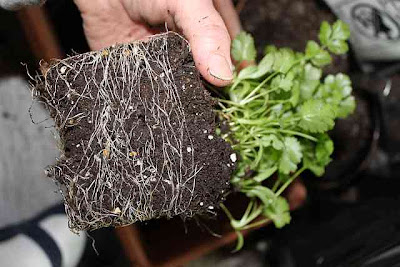
According to the Internet, you aren't suppose to transplant cilantro. You know how well I follow directions. Yup, I just ignored the all wise and did it anyway. Since I barely disturb the roots, I didn't have a problem. This will be a lovely addition to salsa. I also have cilantro started to go into my flower and herb garden. The one we are doubling in size this spring. They say cilantro quickly goes to seed when the weather gets hot. Our weather isn't really hot but we shall see what it does. I'm hoping for seeds so I'll have seed for a new indoor crop this fall and coriander, (the name of the seeds) to cook with.


I started some broccoli also. In our area we can direct seed broccoli into the garden but then the broccoli plant is small when the flea beetles arrive - hungry. They damage the larger plants but don't demolish them as the small ones they eat to the ground. There are also some red early cabbage under the grow lights. I have started them in order to gain an earlier crop. (Remember, I'm going to extending the season.) Then I can direct seed some for a later harvest also.


Since I'm seeing green in my flower bed, it must be time to plant kale, spinach, and other hardy crops in the garden. When I'm going to get that done, I'm not sure.


Thursday, April 7, 2011

There Here!

There here!!! After a long labor, the triplets have arrived. Looky here at this little doeling, such an interesting color pattern and she has her show stance already down pat. Just an hour old and already full of personality. She tugs at your clothes and follows you around or goes wondering off on her own to explore. I'll have to keep an eye on this one. Her older sister remained a bit hunched up the whole time but she did try to buck within an hour of birth. She is a dark beauty.
Then there is the buck. We'll see whether he remains a buck or is transformed into a wether. He is purebred with excellent bloodlines, so we'll see how his conformation turns out.


Got to go, it's time to shut the door on the shed and tell them goodnight.

Tuesday, April 5, 2011

Who Me?

Who Me? Yes, you. You who makes my life so interesting and insists that I practice my cleaning skills throughout the day. You who is teething and needs lots of cuddle time.
Oh how I love you!!!

Yes, this little love bug is at the age of discovery. She's testing to see what happens if she does this or that. When I handed her a fourth a cup of chocolate milk the other day and turned my back to do dishes - she began to finger paint with it, creating a wonderful landscape scene. She was so cute with her tongue hanging out concentrating, I couldn't scold. I just rushed to get the camera snapping a few shots and then asked her if she was done."I done Mam-ma.", she replied and grinning pointed out the splatters on the nearby wall and the chocolate milk that had dripped off on to the floor. You'd think Mam-ma would be brighter after raising three children but Mam-ma still forgets. Like the other morn when I left the sugar and cereal out while I made a dash into the next room to comb the hair of our two older grandchildren. Time was a ticking and we'd only a few minutes left before we had to leave for the school. Our youngest was a slow poke and so I'd left her in the kitchen alone to finish a hastily made breakfast. Yup, that's sugar adding sparkle to our youngest's hair and clothes. Of course she'd spread sugar all over the counter it was sitting on and it spread onto the floor below. Note the top of a chair in this picture. They are such handy things aren't they? LOL
When I came upon this disastrous scene our cutey pie held up her hands for me to see and declared, "Sticky!!"
Minus sticky hands, that's just how we had to dash off to school or be late.


Of course this little episode was after she'd spread her bowl of milk and cereal all over the table and floor. Now exactly how long does this stage last? Maybe it won't be as long as I remember. I've forgotten so many other things like keeping everything put up and away from little equisitive minds. I know she's just learning what will happen IF... and as a Grandma I'm slow to anger and instead shake my head, scold myself for leaving things in her reach, and run for the camera. I've got to have evidence to show my hubby what his youngest was up to today.


Then I ask our cute little bug what she's discovered. What I want to learn though is how to detect the sound of a chair being moved across the floor. How does she do it? We have wood and tile flooring and still she can get a big wooden chair all the way across the room and I don't hear it. Yet, I swear I can almost detect a pin being dropped on the other side of our home. Not that our home is very big but STILL. Her skills are amazing.


Then there is little miss dress up and her zillion sets of clothes she's tried on. Note the socks, their mine. For a week she insisted on wearing my sock. What a hoot. Yup, this Grandma's days are full indeed. So if you are wondering why I often have only one heavily researched topic a week, know that it's because it takes me four to eight hours to create that blog post. And though I'd really love to go hip hopping around to visit other folks blogs, especially right now I don't get to peek very often. If you are a follower, then I make it a point to go into your bog every couple months at least and scan a few posts. I enjoy seeing what you are doing but with spring upon me, I've not been getting that done well. Hopefully, I'll get a chance but right now I've three little ones who's world just got tipped upside down again, our grown children, plants for our garden growing in the basement, livestock which are mutiplying, a knife business, and we are remodeling our home inside and out. Whew!!! just like you I'm buried under busy.


I've decided I'll never get the seven new blogs I'm suppose to visit and the seven things I'm suppose to tell you that you don't already know about me done. But I do want to thank Jillian for granting me a Stylish Blogger award. It is flattering that she thought of me. so head on over and visit her at --- http://jillianjordan.blogspot.com/2011/03/award.html
Meanwhile I've got to go, little bug is taking a quick nap and my kitchen is a mess. Yup, I'd better get it cleaned up before she discovers something else to transform into an art progect. Stay tuned because Chicory has just got to go today. I've been up off and on all night checking her. If she doesn't hurry I swear those kids are going to simply fall out her back end she's so tipped in her hips and she's a sinking in in the flanks


Have a wonderful day!!!

Monday, April 4, 2011

Why Yaks?


Don't have a clue how to copy a picture of Jasmine and Gracie to put on this page so if you want to see them you'll have to go to the sale page on the web-site and take a peek. Christy, the ranch manager says the photos do not do them justice.


What am I yaking about? Well, we purchased two yaks way up in Kalispell, MT. They will arrive the beginning of May. And since some of you have asked why we are investing in such an adventure, I'll give you a little background. As I was researching yaks, I came to the realization that our livestock had to start making ends meet. Tougher times are ahead with grain prices sky rocketing and it will become worse as the farmers pay dearly for fuel to run their tractors. I hate to think about this fall when summer's increase in production hits the market as expensive grain. It's not only grain but hay also that will be a whole lot more money. So I've got to seriously re-think our animal projects, become smarter in the way we do things like raising some sunflower seeds and greens for the chickens, and figure out how our stock can start paying their own way.


I'm going to have fewer chickens, since right now I have too many eggs. A better quality of chickens because these didn't lay worth a hoot in the winter. I may even invest in a solar light to put in the coop since light goes through the pupil and stimulates the pituitary gland to produce eggs making our fewer chickens produce more. Some chicken breeds need less light than others to get this job done. I've got some chickens on order right now from a different hatchery than the one I've been using and we'll see how they perform. Previously I used McMurray. I found that their sex link breeds laid well for me but none of the other traditional egg breeds. They've gone to show lines, not high producers. I want good conformation but more than that heavy production with economical feed consumption.


Our three year old goat, Chicory has blood lines that should command a decent price for her pure blood kids and she was a wonderful milker last year due do her heavy milking genes. Contessa, her daughter, will have to be a good milker and throw nice kids this year though she isn't pure blood but her dad was no slouch having come from the same breeder as Chicory. Contessa's kids may not bring as high a price but we'll keep her for now to see what she throws. Katarina, her sister, will have to go down the road when I get her fully tamed and trained at the milking stand. She is a really nice doe but not the quality of her sister.


I've gotten side tracked here in our discussion and I'd best get back to the subject of this post, yaks. It was research that sold me and made me decided I should try my hand at a more serious adventure. One that included giving workshops but we'll talk about that later. I'll tell you about the yaks. We've contacted seven breeders and visited with a few of them on the phone. At first I just wanted ONE yak as a gift for my husband as he is a very hard person to buy something for. I thought we'd probably get a steer and raise it for meat. Then research entered the picture and I learned that you can't have one yak or they will become depressed, possibly not staying in their pen or pasture. So we brain stormed. A cow and a calf won't do either, we learn. The yaks have to be of companionable age.


After hours of research, of which there wasn't nearly enough to satisfy my questions, we decided on two yearling woolly yaks. Yes, I know they are all woolly but these have an increased production of yak wool. I don't know how much increase in wool yet but we are interested in selling the wool. The Internet sells it for $20 to $24 an ounce cleaned and de-haired, ready to spin. What it costs to get the wool de-haired, I can't find YET. I may have to save wool for a few years and who knows maybe I'll take the cleaned and de-haired wool, spin it, and knit hats for sale. All this could change in the future as prices and demand change so I'll leave the decision to then. I did find some yak yarn that sells for $30 to $36 a skein. That's above my expenditure range for yarn.


I heard that yaks only produce a couple pounds a year. Even if I got only $5 dollars an ounce in the raw state. It would be $160 dollars a yak and that is $160 dollars more than a beef who produces nothing. Something more to off set the cost of raising the animal. As the yak matures, it the wool yield is greater. The whole idea of woollies is to have more wool so that's what we chose. They have extreme woollies too but none for sale that we found in the neighboring states. If we had bulls, I'm sure our production would go way up since a mature cow averages 600 to 800 pounds - 4.5 feet at their hump and a bull weighs up to 1600 pounds - 6.5 Feet at their hump. A huge difference in body surface area to comb wool from. Just so you can compare, a calf averages 30 pounds when born. Those of you who are very observant noticed that I said comb. Yes, you comb the yak when they start to shed to remove the wool. The long guard hair does not shed. This is the hair that hangs down off their belly and tail. Combing does take more time as it must be done daily in the spring when they are shedding. Sheep on the other hand are sheered once a year. Add in that sheep produce far more wool in a year than a yak and you can see why the high price tag for yak wool.


That is one of the big reasons why we bought halter broke, gentle yearlings. We don't have a chute to put them in and lock their heads so we can comb a wild beast. If you have Netflixs, go to Dirty Jobs season 4, episode 2 and you will see the star of the show at the Springbrook Ranch combing yaks and bison. This is the same ranch our yearlings are coming from.


Even though the long hair does not shed, in some countries it is sheared off every couple years as it is very strong and can be braided into ropes etc. I think it would make a cool braided headstall. Those that I've seen are made from horse tail. Why not yak? I did read that yak hair makes the best theater wigs. I'd of never of thought of that.
The wind is now coming out of the West. A good sign that colder weather is blowing in. "Do you have harsh winters?", was one of the questions asked by sellers. Good they replied, you'll need them. It is nasty, cold weather that causes the woolly undercoat to develop. Our area is eager to please such request. We just had snow which closed the roads around Cheyenne, WY This long stretch of clouds at sunrise is another good sign weather is changing. If that isn't enough, all I have to do is put sunflower seeds in the bird feeder and the sparrows and finches will tell me when a storm is approaching. They empty the feeder in a hurry. Sunday evening due to high winds that produced a blizzard. It wasn't too nice here either. It kept our oldest daughter from traveling home until the next day. This weekend we are expecting snow again. I know it is April but we can get snow into June and in the mountains July. Yaks don't mind though as they are a high altitude, wind, cold loving animal. Their long guard hair provides a comfy bed and their woolly undercoat being warmer than Merino wool by 15% 20% lends them excellent protection. In fact, it is the heat that is their undoing. Think of wearing a heavy down coat in the summer and you'll understand why. We don't have humid or hot summers at 5000 ft. this far north making them ideal for yaks. They can handle an altitude of 10,000 ft. because of their unique ability to retain oxygen. This unique quality makes their meat high in Omega 3's. Something most meat, except a few fish, are low in. But I'm getting side tracked again. Let's finish talking about their wool. It's warmer than Merino, equal to cashmere in softness, and several tests show it is stronger than sheep's wool. The down side is the staple is only and an inch long. Not many places have the equipment to process this short a fiber and de-hair it. Yak's hair is silky enough though that it isn't prickly so a little in the wool I'm told is not uncomfortable. A whole lot more than I can say for its relative the bovine. I once combed my daughter's FFA steer in the spring to collect the wooly undercoat, then spun it into yarn. It's called Poor Mans Wool, just so you know, and you'd have to be desperate to wear a garment made from it without de-hairing. The yarn looks like a woolly caterpillar. Cool looking but pricklier than all get out. Not so with yak as the hair is soft. I'm not worried about spinning yak wool though because they say it has a lovely crimp that lends ease in spinning. I love working with camel down which also has an inch staple so I'm not concerned. For you allergy suffers, yak down is hypoallergenic. The second selling point of yaks is that they eat less than a beef. One site said 1/2 the amount of bovines and the others said 1/3 less. I'd guess it would be whether you are feeding a cow or bull. Either figure means that yaks are more efficient at feed conversion. For those of us who have studied cow manure for livestock management reasons, you've noticed quite a bit of forage that has gone undigested. Yaks are said to find food and do well where beef would starve. Not that I'm sanctioning testing that theory mind you. That would be cruel and miss my point of having yaks. Disease resistant and hardier than cattle puts them ahead in my book also. If need be we can use yak manure for fuel in our stove. Our county, like Tibet has very few trees. Lots of coal but hardly any tree cover. I'd rather have coal but it's nice to know yak manure is available if I become desperate. The large herd of bison on the ranch just a mile north of us would supply a similar product. Bison manure was what the Plains Indians used to cook over. The Tibetans use yak.
Yak meat, no fat, doesn't it look juicy? Third, the yak produces an exceptional meat that is better for you than beef. The down side is that yaks take longer to mature, 5 - 6 years. You don't have to wait that long to butcher one as I'm told three is when many find their way into the freezer. During this time they receive no grain. Yaks are far more intelligent and intuitive. That can be good or bad as John, the rancher we visited, said he couldn't even think the word butcher or he swore the yaks wouldn't come into the corral until a day that thought didn't enter his mind. LOL Yak is higher in vitamins, much higher in Omega 3's than beef, lower in cholesterol, calories, and the meat is not gamey or greasy. I'm told the fat is on the outside of the meat, similar to pork, or bison. We brought a little hamburger home from our trip last weekend and cooked it on a high heat over the barbecue grill to seal in the juices, cooking the meat to medium rare. It was juicy and flavorful. Not at all gamey just like they said despite not having been fed any grain. I've a chart I found by Midwest Lab Inc., a USDA accredited laboratory.
4 ounces of Meat

Yak

Calories 154

Cholesterol 49 mg

Fats 6.10 g

Protein 24.7 g


Beef

Calories 300.71

Cholesterol 89.31 mg

Fats 19.42 g

Protein 29.3 g

Beefalo (Beef/bison cross)


Pork

Calories 195.58

Cholesterol 89.31

Fats 6.84 g

Protein 31.4 g


Chicken

Calories 220.09

Cholesterol 93.84 mg

Fats 8.69 g

Protein 33.2 g


Beefalo (bison/beef cross)

Calories 212.53

Cholesterol 65.57 mg

Fats 7.14 g

Protein 34.6 g


Yak is the lowest in calories. The lowest in cholesterol. The lowest in fats. Hand over the yak is what I say. The hamburgers were yummy and moist, no fat was added like in beef hamburger.You do have to cook them for a shorter period of time or they will go tough so those of you who like well done. Well, how to I put this politely. How about, you don't know what you are missing as meat should never be cooked that long. It looses its tenderness and flavor especially yak.


Fourth reason, they are just cool looking and have a great personality. They also sell for a good price. $400 and up for a newborn. $400 being ones without registry and fancier breeding. Gracie and Jasmine are papered. The reason we were told you should buy registered is that you then know who the parents are.


Yaks have NOT been exported from their countries of origin in one hundred years. Our U.S.A. yaks come from European zoos.


In fact, I think it's Jasmine that's line can be traced directly back to a zoo in Europe. Because of this small gene pool, it makes line breeding an issue if you don't know who your yak's parentage is.


Fifth reason for buying yaks is they make great pack animals. They can carry the same approximate weight as a horse. There is a business in Steamboat, Colorado that offers pack trips with yaks. Don't know if we will pack our yaks, has a nice ring doesn't it - a pack yak, but we might train one to pull a cart and let the kids ride them. After all they ride them in Tibet.


Sixth, is that we want to try their milk. I can't find out much about it other than butter and cheese is made from it, few drink it. No one we contacted, drank it or made something from it. I do know it is high in butterfat. We shall see because in a couple years, I'm going to milk our girls.


So there you have it. The reasons why we are investing in yaks.

Sunday, April 3, 2011

Yacking About Yaks

Poor Guy, I had enough questions to drowned a floatation device. The yak owner, John, was a good sport though and tried to answer them as best as he could. Unfortunately for him, me being me, had lots of technical ones and John admitted he had no prior livestock knowledge and was raising yaks for the shear pleasure of it - not scientific discoveries. Oops, maybe I was drilling him a tad too much. I was a good girl though and backed off. I know mentally that everyone does things for different reasons but being the extremely inquisitive person that I am, I what to know the why's for everything. It is one of my greatest pleasures in life. The excitement of discovery.Often my inquiring mind isn't really because I'm so adventuresome. It's because knowledge usually makes me less uncomfortable and afraid of things, empowering me with a set of options and a slight bit of control. I don't always find surprising delightful. You could probably say that I'm just a really big chicken.


You mothers can probably imagine how I must have driven my mother nuts when I was little. "How come the sky is blue Mommy? How come - How come- How come-? Okay, maybe I'm still that little girl and though Mom hasn't admitted it, I probably still drive her nuts.


Of course she can probably say nanner, nanner, nanner, because the shoe is sometimes on the other foot as it was yesterday. "Grandma, is it really true that I have eggs in me, asked our oldest grand daughter, who's six? "There not like chicken eggs though, Grandma." Where did that one come from? LOL

****************


I greatly appreciate John's patience and his graciousness in allowing us to come and view yaks up close for the first time. Pretty cool, aren't they? This cow is my favorite. John, bless him, couldn't give me the finer points of conformation that a show ring judge would be looking for but I declared that I thought number 55 was the best cow in the bunch.

My favorite, hands down, was number 7, the bull. He really should have been given the name Gentle Ben. I lost my heart as I fed him cake, livestock cake that is, a feed supplement in a large pellet form. He came right up to me and stretched his neck out, every so carefully taking the feed from my hand. He then just stood next to me as I stroked his long haired face. I've ridden some bulls in my time as a kid, not something I'd recommend for our grand daughters, but I'd put them on this guy. He'd probably take good care of them. Wish I was little. I'd try riding a yak. What shocked up the most, was how small yaks are. Granted, the bulls we have been looking at on the Internet are big, not tall, but big - some 1780 pounds. The cows are 600 - 800 pounds and the calves average 35 pounds at birth. Unfortunately, we didn't get to see any calves. They are so cute and little on the Internet. And though I could feed cake to these cows, they were flighty and really quick.
If you, like me, want a yak of your own, there are some stipulations your area must have. High elevation and cold winters are a must. They can't handle the heat. It was one of the questions asked of us when we inquired about buying yaks. I told the ranch in Montana, they'd feel right at home with our elevation, occasional 50 below zero Fahrenheit windchills and howling winds.


This gal is an Imperial Trim. How do I know? The Internet of course for I've been studying about yaks. One gentlemen who had a few head in Colorado said there was lots of information on the Internet. He didn't know to whom he was speaking to for I find the information very sketchy and it doesn't cover nearly all my questions. LOL


It did inform me of the breeds though. We haven't many as no yaks have been exported from their native countries in 100 years. All ours in the U.S.A. have come from zoos in Europe. So I can tell you that this is a Imperial Trim because she is a cross between an Imperial yak and a Royal yak. The dark nose and body hair tells me she from an Imperial and the white spot on her forehead tells me she is from a Royal, which has large black and white splotches.The cow on the right is older as her horns are starting to curl.
Maturity is reached at 5 to 6 years old.This is a yearling bull and the size we are buying.