Life if far too exciting for me. Too many troubles but it is the nature of growth so I guess I'll just become a little more knowledgeable once more.
Our son was just diagnosed with a suspected Tularemia infection, a rare infectious disease that can attack the skin, eyes, lymph nodes, lungs, and less often, other internal organs.
Our son has a tick bite that has not healed and drastically swollen lymph nodes with major flu like symptoms that come and go with exertion.
But one can contract the disease in many more ways. The CDC (Center for Disease Control) site says that Tularemia can be spread in the following ways:
being bitten by an infected tick, deerfly or other insect
handling infected animal carcasses
eating or drinking contaminated food or water
breathing in the bacteria, F. tularensis
The disease mainly affects mammals, especially rodents, rabbits and hares, although it can infect birds, reptiles and fish. What an odd assortment. Luckily I've taught my children that if the doctor's answers don't add up, just keep going. The third doctor our son went to see called a specialist on Bubonic Plague, Colorado or American Tick Fever, Lyme Disease, and Rocky Mountain Fever, all diseases they looked at in the beginning. The cure is the same antibiotic so pinpointing the cause is not necessary.
Though I do know a little about Rocky Mountain Tick Fever. My step-brother had that years ago. He had a very distinct smell to his body odor. One of the things the doctor used to identify his disease.
The symptoms are different depending on how you contract Tularemia and that also effects just how deadly the disease is. If treated, less than two percent die. From what I can tell inhalation can cause 50 to 60 percent death rate if not treated. So if a rabbit doesn't look healthy keep a wide berth. I don't care if it is Rocky Mountain Fever, Colorado Tick Fever, or Bubonic Plague, they are all nasties.
What makes Tularemia confusing is that depending on how you contracted the disease your symptoms will be different. Enough to confuse most doctors especially when you factor in that the disease is now rare.
A much different story in WWII when the disease was common. The United States was very different from now. Farmers alone made up 21 percent of the labor force. Produce from victory gardens and rabbits were what was for dinner, not beef as today's slogan implies. Rabbit on the table would include domestic and wild though I'd guess it was wild more than domestic that caused the problem. Kirk's grandpa raised beagles to hunt rabbits and that was pretty common also. There is a vaccine against Tularemia and Kirk's dad remembers getting several shots for different types of tick fevers, this being one of them. He spoke to our son of a friend that died from Tularemia.
My oldest sister also remembers tick shots but I don't remember such things. I do remember the sugar cubes with the red dot of medicine on top that we ate and they said was to protect against polio. I wished that all my vaccines were in that form.
Then United States change. People moved to the cities. They seldom go outside and sit inside watching television, playing computer games and the like. Not much risk of rabbit fever there. Farmers have become a dying breed. The average age of a farmer in 2011 is 58 in the US, 58 in Australia, and 66 in Japan. People don't roam outdoors like they use to. And many parks and area you are not allowed to get off the trail. So except do it yourselfers, no one eats rabbit. When was the last time you saw it on your local restaurants menu, never.
But the thing that I found far more disturbing was that fish and birds can get Tularemia. Never heard of a case like I have from rabbit but I guess it is possible. The disease can stay alive in water and the soil for weeks. That is why the CDC considers it a possible biological weapon, particularly as a airborne contaminate.
Since Tularemia is potentially fatal ,if not treated early, it is wise to check things out and in our son's case check it out several times until you get an answer that feels right. Since our son is an avid hunter and has a bird dog, he is at a greater risk. He pulls ticks off of the dog and himself particularly in the spring. I remember pulling a good share off of our kids when they were growing up. It is a part of rural life so beware. Not all ticks just suck blood. Some give more than they take.
Wednesday, July 31, 2013


Monday, July 29, 2013
Sourdough Baguettes
How in the world do you say baguettes? I say it like it has a q instead of a g. I had to go search on the Internet even though I'm not giving this class in person. http://www.howjsay.com/index.php?word=baguette&submit=Submit I found this fascinating site. It actually says it out loud instead of those confusing little squiggles above the letters. No big surprise, I have been saying it completely wrong. I'm not exactly from a culinary family. Meat and potatoes is all my father ever wanted, after all his family is from Idaho.
I've always loved to cook though I wasn't particularly good at it. With Mom seldom home and a girlfriend who's parent's gave us free rein in their kitchen, she had six younger brothers to eat the results, I cooked my way through childhood. But it wasn't until I was married to Kirk that I really discovered my love for food. For real food that had fresh wonderful natural flavors. This love has been spurred on as Kirk travels a few times a year to large cities with their wonderful selection of eats and he comes home with tales of tongue tickling delights.
We have learned to savor food. Something you just don't do with tator tot casserole or tuna fish casserole, staples when I was a kid. It is no wonder I put ketchup on everything including corn.
My parents still don't see what I see in food but that is okay. My husband LOVES to come home after a long and I mean long 14 hour day at work to a home cooked meal. Last night it was cube steaks dipped in egg and a mixture of dried bread crumbs, flour and salt and pepper fried up nice and crisp with a spicy Alfredo sauce on top. One where I used fresh cream, home bottled half dried tomatoes in olive oil and spices, a little butter, black pepper, basil, parsley, and lots of Romano and Parmesan cheese. A side dish of rice and another of green beans and yum, we were set for mouth watering fun.
This morning it was home-made cinnamon raisin bread and a fruit smoothy with home-made yogurt swirled inside. Yes, my family loves it when I live in the kitchen. Unfortunately at times it is feast or famine. It has been feast lately.
New excites mea and catalogues for cooking supplies that also give recipes are high on my list of good things. Two of the several new sourdough discoveries have come from them. This makes my sourdough start especially happy with all the use.

Baguettes
1/2 cup (4 ounces) fed sourdough starter
3/4 cup ( 6 ounces) lukewarm water
1 teaspoon instant yeast
1 1/2 teaspoon salt
2 1/2 cups ( 10 1/2 ounces unbleached all-purpose flour
Being as this is a recipe from King Arthur Flour, they are recommending using their flour. I do love their bread pans and order their cake flour since it doesn't have those nasty extras in it, but I use Montana Wheat instead of their flour. I believe when possible and affordable to use local. Local may be a state a way since we aren't a big crop state but I want to encourage something so... basic as close as possible. Montana wheat all purpose comes in unbromeated and unbleached. I love how the cold harsh white is replaced with a warm light yellow without all the refining. I'm not a lover of white. Probably a hold over from childhood when I would scream whenever I saw someone in white, fearful that they were another doctor to poke and prod me.
Now for the instructions. These are from King Arthur Flour.
Combine all of the dough ingredients, kneading to form a smooth dough. (This takes only a few minutes)
Allow the dough to rise for 1 hour. Refrigerate, covered, for 12 to 18 hours.

This is where I left the recipe behind. Instead of making a baguette, I rolled the dough out into pizza circle on to parchment paper and let the dough rise for well over an hour. Wish I had timed it but the whole point of using this recipe as a pizza dough was the flexibility of it. Make the dough the day before and let the dough rise for an extended time while the busy evening routine took me away.
I put all the toppings on knowing that livestock chores had been kept waiting and when I got home Kirk would have arrived. I called Kirk as he was traveling home and asked him to put the pizza stone in the oven to heat while I finished chores. I wasn't too sure how this all would turn out as I don't normally put tomato sauce on too soon as it makes the dough rather soggy.

I should not have worried because it came out nice and crisp on the bottom and not a bit soggy. The dough had a bit of chew just the reason why we love artisan bread. This is definitely a keeper as a pizza dough.
Now for what I was suppose to do.
Divide the dough in half. Shape each piece into a 15" to 16" baguette, and place on a lightly greased or parchment-linved baking sheet, or into a baguette pan. cover and let rise until very puffy, about 3 hours. Towards the end of the rising time, preheat the overn to 425 F.
Spray the baguettes with water and make three fairly deep diagonal slashes in each. ( I did not spray mine with water.)
Bake for 25 to 30 minutes, until baguettes are a deep golden brown. Remove from oven, and cool on a rack.

I went back and make the dough as baguettes too but still love it as pizza dough more. Definitely a keeper recipe. Give it a try and see what you think.
The roll you see next to the baguette is sourdough too but an entirely different recipe. I'll be sharing that one too. It is from the Cuisine magazine. As it has 2 cups of sourdough start in the recipe, it has a distinct sourdough flavor unlike the baguettes which is just a yummy bread. I liked the baguettes better and Kirk the sourdough rolls. To each their own so these two are going in my separate sourdough file for sure.
Now to try sourdough overnight waffles and sourdough Ciabatta. Two new recipes awaiting my trial.
I've always loved to cook though I wasn't particularly good at it. With Mom seldom home and a girlfriend who's parent's gave us free rein in their kitchen, she had six younger brothers to eat the results, I cooked my way through childhood. But it wasn't until I was married to Kirk that I really discovered my love for food. For real food that had fresh wonderful natural flavors. This love has been spurred on as Kirk travels a few times a year to large cities with their wonderful selection of eats and he comes home with tales of tongue tickling delights.
We have learned to savor food. Something you just don't do with tator tot casserole or tuna fish casserole, staples when I was a kid. It is no wonder I put ketchup on everything including corn.
My parents still don't see what I see in food but that is okay. My husband LOVES to come home after a long and I mean long 14 hour day at work to a home cooked meal. Last night it was cube steaks dipped in egg and a mixture of dried bread crumbs, flour and salt and pepper fried up nice and crisp with a spicy Alfredo sauce on top. One where I used fresh cream, home bottled half dried tomatoes in olive oil and spices, a little butter, black pepper, basil, parsley, and lots of Romano and Parmesan cheese. A side dish of rice and another of green beans and yum, we were set for mouth watering fun.
This morning it was home-made cinnamon raisin bread and a fruit smoothy with home-made yogurt swirled inside. Yes, my family loves it when I live in the kitchen. Unfortunately at times it is feast or famine. It has been feast lately.
New excites mea and catalogues for cooking supplies that also give recipes are high on my list of good things. Two of the several new sourdough discoveries have come from them. This makes my sourdough start especially happy with all the use.

Baguettes
1/2 cup (4 ounces) fed sourdough starter
3/4 cup ( 6 ounces) lukewarm water
1 teaspoon instant yeast
1 1/2 teaspoon salt
2 1/2 cups ( 10 1/2 ounces unbleached all-purpose flour
Being as this is a recipe from King Arthur Flour, they are recommending using their flour. I do love their bread pans and order their cake flour since it doesn't have those nasty extras in it, but I use Montana Wheat instead of their flour. I believe when possible and affordable to use local. Local may be a state a way since we aren't a big crop state but I want to encourage something so... basic as close as possible. Montana wheat all purpose comes in unbromeated and unbleached. I love how the cold harsh white is replaced with a warm light yellow without all the refining. I'm not a lover of white. Probably a hold over from childhood when I would scream whenever I saw someone in white, fearful that they were another doctor to poke and prod me.
Now for the instructions. These are from King Arthur Flour.
Combine all of the dough ingredients, kneading to form a smooth dough. (This takes only a few minutes)
Allow the dough to rise for 1 hour. Refrigerate, covered, for 12 to 18 hours.

This is where I left the recipe behind. Instead of making a baguette, I rolled the dough out into pizza circle on to parchment paper and let the dough rise for well over an hour. Wish I had timed it but the whole point of using this recipe as a pizza dough was the flexibility of it. Make the dough the day before and let the dough rise for an extended time while the busy evening routine took me away.
I put all the toppings on knowing that livestock chores had been kept waiting and when I got home Kirk would have arrived. I called Kirk as he was traveling home and asked him to put the pizza stone in the oven to heat while I finished chores. I wasn't too sure how this all would turn out as I don't normally put tomato sauce on too soon as it makes the dough rather soggy.

I should not have worried because it came out nice and crisp on the bottom and not a bit soggy. The dough had a bit of chew just the reason why we love artisan bread. This is definitely a keeper as a pizza dough.
Now for what I was suppose to do.
Divide the dough in half. Shape each piece into a 15" to 16" baguette, and place on a lightly greased or parchment-linved baking sheet, or into a baguette pan. cover and let rise until very puffy, about 3 hours. Towards the end of the rising time, preheat the overn to 425 F.
Spray the baguettes with water and make three fairly deep diagonal slashes in each. ( I did not spray mine with water.)
Bake for 25 to 30 minutes, until baguettes are a deep golden brown. Remove from oven, and cool on a rack.

I went back and make the dough as baguettes too but still love it as pizza dough more. Definitely a keeper recipe. Give it a try and see what you think.
The roll you see next to the baguette is sourdough too but an entirely different recipe. I'll be sharing that one too. It is from the Cuisine magazine. As it has 2 cups of sourdough start in the recipe, it has a distinct sourdough flavor unlike the baguettes which is just a yummy bread. I liked the baguettes better and Kirk the sourdough rolls. To each their own so these two are going in my separate sourdough file for sure.
Now to try sourdough overnight waffles and sourdough Ciabatta. Two new recipes awaiting my trial.
Thursday, May 30, 2013
Udderly Confused At First

I spend a great deal of time fussing over decisions of what goats to keep and what ones to get rid of. Then I started breaking each one down. Their faults and their good points. I decided what was most important to me. I learned that I'm so... into udders. Half of the points for linear appraisal is for udder. To me that is mainly what a goat is all about, the udder or they wouldn't be called a DAIRY goat.
So at this time of year when I'm looking at who to keep and who goes down the road. The udder is the thing I'm looking at most carefully. This is Megan's. Discard the cow hocked look because she isn't that cow hocked but always stands goofy on the milking stand. The escutcheon could use a better arch. This one comes to a peek a little but for capacity this is pretty awesome especially since she is two and this is a picture of her udder at three weeks freshening with her nursing twins.

The udder isn't perfect but far above average I'd say. I'd like to see it collapse down to nothing when empty but it doesn't but the daughter I kept of hers does. I still get a 1/2 a gallon of milk a day besides Megan nursing twins so I can't wait to see what she produces when they are weaned. Her ears could be longer but what really do ears do for a milk goat? Lamanchas don't have any. And her nose is too small. Her hocks could have a little more angle and her back should be flatter though it isn't bad. She has a nice long rump and is a very big girl for two. She has a very classy smooth appearance. Her dairy character is developing nicely. Something she didn't have a lot of as a yearling. Over all, I like this doe.


The udder on the left is Megan's right after she freshened for the first time last year. The one above is at three months. The one on the right is her daughter Mercedes just a few weeks after she freshened. It is an improvement on mother. This girl looks a lot like mom and her son is probably the best buck born this year. That makes me super happy because this is Chicory's great granddaughter. I can't wait to have her linear appraised and compare her score to her great grandmother's and mother's scores. It will tell me just where I'm moving forward and where I might of lost ground.

As for Daisy here. Her udder looks a great deal like her mother, Chicory.

I've made a choice as to what doe to get rid of. The shocker is how much she developed cow hocks from a kid to this year. I would not of dreamed it. I'd like to tell the person who will be receiving her first before I blab all about it on here but some of you will probably figure it out. That will give me three does and a maybe four if I keep the little brown doe just born. She is so tiny I don't really know what she looks like. And I've decided on only keeping two of the seven bucks intact. The rest will be banded. But first will check with an interested party to see which buck they might want of the whole group. Will I sell these two or keep them, I haven't decided yet.
The biggies in my book when deciding on whether to keep a goat or not is:
Udder shape and capacity ( I have dairy goats for the milk) Taste goes without question because we use it.
Structurally sound or correct (That doesn't mean perfect but no large faults.) Extra points go to a doe who doesn't pass on her faults. If she consistently has kids better than she is and they are uniform to each other then she scores big.
Body capacity (If she isn't big enough, she can't sustain a large udder)
Has multiple births by two years old as mutiple births equates to more milk. Plus she doesn't require help with birthing. (Chicory was the exception because it wasn't genetic and all her doe kids have kids on their own.)
Personality (This is huge as I have to milk the doe twice a day and who wants to deal with a headache that often?)
In personality mothering ability is included. Megan is a bit of a pain at first when she kids but each year she is getting better and her other qualities make up for it. Her daughter didn't do so well this year but part of that was my fault so I'll give her another chance since she had the nicest kid and has a kick butt udder. She is a dream to milk too so she remains.
Personality also includes how well they get along with other goats. I have NO BIDDYS in my herd. Cranks go down the road in a hurry because I want to be able to put more than one mom and her babies together in the same pen and shed. Crankiness is genetic and taught to the offspring so they get a double whammy. We once had a doe break ribs on a doeling of another goat. Yes, she hit the road.
I had a women complain once that the goat she bought from me was too nice and ended up much skinnier than the rest of her goats because she wouldn't fight at the hay feeder. I say, weed out the the old biddies and replace them with sweet mild mannered ones. They just aren't worth it. There are lots of nice does that give lots of milk and you will thank yourself 365 days of the year.
As for bucks, well I just don't know what you keep. I'm going on linage, what their mom and dad looked like, and if they are an improvement presently. I'm never sure how they will develop as I would have never though one of the goats I got last year would develop such cow hocks.
It is why I do linear appraisal. I learn a tremendous amount each year. I've only been doing it one year and watched the year before. I'm sold though. I will be doing it as a learning experience from now on.
As much as I've learned from this experience I'd highly suggest you undergo this same journey. Learn what is most important to you in a dairy goat. Break each goat down structurally and by personality. A wise Linear Appraisal judge told me that you can have one pet goat. The rest have to pay their way. That means being cut throat he said if you want to improve your herd. I agree. I don't have the money to pay for goats not performing. That is just a hard fact of life.
Tuesday, May 14, 2013
Sprouts, Yogurt, and Sour Cream.
 Sprouts sounded good and since we are in a get healthy kick, I pulled some seeds out of the refrigerator and started sprouting.
Why we don't do this all year is beyond me but come spring I get in the mood for sandwiches and salads with this healthy choice. What can be simpler than placing cheese cloth on top of a jar held on by a jar ring and watering down seeds several times a day? So why don't I do this all year is beyond me but I find my food cravings have a seasonal drift.

Besides the vinegar cheese I made a second batch of yogurt. A second batch because I took part of the yogurt I'd made last weekend and used it to culture some more of the yummy stuff. I separated milk and today I've got to do something wonderful with the cream. Last weekend I separated and made cream biscuits for the freezer. You make up the dough and freeze individual dough circles. Then when you want biscuits you pop as many as you want into the oven.
I'm planning on biscuits and gravy one of these nights since we have fresh milk once more. So biscuits are out but I'm thinking of Alfredo sauce. It freezes well too and is a handy quick meal for these busy days where there just isn't enough of you to go around for all the chores needing done.

Then since my yogurt maker was full of yogurt and I still had a little yogurt left I had to get creative about where to incubate the sour cream and the rest of the yogurt. Here is what I came up with. I have baby chicks under heat lamps in the basement which will soon go outside and why not get double duty from the heat? I thought it was clever but then maybe I'm easily impressed.
You see I've heard of making yogurt in a thermos and placing it at the bottom of a sleeping bag while camping so the heat of your body keeps it warm. I have put a heavy pot on the stove with water in it and heated the water to the 112 F. Then turned off the stove and kept the temperature fairly constant turning the stove on and off through the day. Not my favorite way but it works in a pinch. And I've heard of using a pilot light to produce the heat.
The one method I couldn't seem to get to work was the crockpot one. Maybe I need a better crockpot that has more than off, low, and high. It's about using what you have and making do. A skill we should all develop more fully. It's good for the brain and the pocket book. How do you incubate your yogurt?
And what was I doing while all this milk and cream was heating to the proper temperatures, watching Netflix and spinning wool, what else. It was evening and I was nearly all done in.
Friday, May 10, 2013
Signs of Impending Birth

Find yourself looking at the south side of your goats a lot lately? I've been doing just that to not only my goats but a couple friend's goats as well. I was assisting a gorgeous doe named Capella yesterday and once more the signs of impending birth came to mind as I checked my friend's other goats as well. I may get another phone call as one looked pretty close.

What was I looking for? I'm looking for the hollow indent in the top flanks showing me that the kids have dropped positioning themselves into the birth canal.

I'm looking for a raised tail head showing me that the muscles have loosened allowing the passage of kids.


(One of Megan's bucks saw an opportunity and dived across the milk stand to latch hold when I had gotten her up to milk. She is feeding these two plus producing a half gallon a day of milk for us. We are so please with this two year old.)
These are all signs that can and I repeat CAN happen before giving birth. Yesterday, Capella's udder was not full, her tail head was not as raised as I'm use to but yet it was loose and she didn't sink in in the flanks as much as I'm use to either. Because of this her owner went off to work thinking she was in the clear that day. You aren't always warned but usually if you are watching closely you will have a good idea what is to come.
Keep in mind that each goat is an individual and every birth a bit different from the last. A particular goat will have some habits and so history is helpful. If a goat gives birth in the morning she will likely give birth within a few hours of that time the next year.
And though you are looking for all the pre-signs and your doe had a full udder last year before giving birth she might not do so this year. Unpredictability is the only thing you can count on.
Madeline, the brown goat and Capella's daughter, has had a raised tail head for a couple weeks. Never had one do that so soon before but there is always a first. What I look for is progress of symptoms and a quickening of change which happens right before birth. In hours the does udder will begin to swell must faster than before, her sides will sink downward, her tail head will become more pronounced and she insists on being in the shed.
Monday, April 1, 2013
Flour Tortillas Recipe

Whoops, hit the wrong button and posted two blogs on one day instead of Monday and Wednesday so beware. It won't be until the end of the week before I post again.
I made Pollo Con Creme and of course Flour Tortillas. I am in love. I predict that I will rarely ever buy tortillas again. Why would I? These are soft, flexible, and not nearly as chewy as the ones from the store and easy to make taboot.
What is hidden in store products that makes them so different than if you were to make it your own? You can use the same ingredients as that on a store product's label and yet the products turns out very different. But the clincher is, are you really using all the ingredients as the manufacturer? We are not getting the whole story.
This might be a clue. For instance the dairy industry is working on eliminating the need to put aspartame on the label of their yogurts and flavored milks. My question being what else isn't on the label now?
Got diet milk? The dairy industry for the past three years has been hoping to sell you some under the guise of just plain "milk," so that chocolate and strawberry varieties that contain artificial sweeteners would no longer need to carry a special label.
Our daughter gets a migraine instantly with just a drop of this artificial sweetener often labeled as Equal. She is very concerned that this will be approved.
But before I get on a whole tirade I'd better stop myself because I get really worked up. Let me suffice it to say that I'm trying hard to eliminate the need to buy as many store food products as possible.
Just so you know, I used some potato flour in my Easter bread rolls, yum, yum. Okay, that was a squirrel moment.

Anyway, with this second batch, I used lard. They turned out even better than the first batch done with canola oil. Not surprising because leaf lard is the best for pie crusts.
I've read lots of tortilla recipes of Hispanic base that had lard instead of shortening or oil so I thought why not? Though I haven't seen a hint of anyone using ghee in tortillas I'm tempted to try. That would add a lovely buttery taste and wouldn't that be good mixed with powdered vegetables in the tortilla shell for a turkey or chicken sandwich wrap?
As for lard, I'm saving store cottage cheese containers to put particularly leaf lard in from our pig we will hopefully butcher this coming weekend. I am determined that I will cook more with lard this year. Any is more than I did last year so I'm not talking a lot, just more.
A lot of butter or lard may not be a good thing but in moderation it is a whole lot better than shortening or margarine any day. Though I make some butter from our goats, I still buy the bulk of it and so I need to work more on transitioning from my dependence to using my own lard, butter, and ghee.
I promised to tell you the skinny. Here it is.
Easy Flour Tortillas
From the Cook's magazine
2 3/4 cups of all-purpose flour
1 1/2 teaspoons salt
6 tablespoons vegetable shortening
cut into 6 pieces
3/4 cup plus 2 tablespoons water, heated to 110 degrees
1/2 teaspoon vegetable oil
This is the base. I of course never once used shortening. But the thing that was crucial that Cook's disclosed was the methodology and reasoning behind it. It is why I love the magazine.
You mix in a bowl the flour, salt and fat of your choice. Then with clean fingers work the fat into the flour until it becomes fully incorporated. It will be a moist flour, freshly ground cornmeal in texture.
Stir in the water until combined. The hot water causes the fat to liquefy and coat the flour and does not allow the liquid to absorb as well. This keeps the gluten from forming and creates the tenderness.
Cook's recommends leaving the dough in the refrigerator for a short period of thirty minutes after rolling into individual balls but I just left my dough on the counter and rolled out after the resting time.
You may need a little flour on your counter when rolling out. I love my granite counter tops for you can often get away with kneading bread or rolling out things without flour and so they are more moist.
I couldn't believe how easy it was to get the shells see through thin. As for cooking them. I used my cast iron skillet. Cook's said the tortilla puffs up and this causes flaky layering but mine when it did this burst and I didn't like the results. I turned down the pan a little and cooked at a slightly lower heat. Each to their own.
Now on to corn tortillas. Cook's has a recipe for them too. I just happened to have a corn tortilla press I picked up at a second hand store a few years ago and have yet to use.

This is electric and is meant to press and cook but my cousin doesn't like the way it cooks. I don't know if she used hot water to make her shells or not and so that may have something to do with why this press works for her. I have not eaten her shells and so I can't compare hers to mine. We will have to do that one of these days.

This is photo of the inside. She understood that this press is not for corn tortillas. I'm just glad I don't need another cooking appliance. But who knows it might work great for you.
Monday, February 18, 2013
Cattail Cordage

every part of the plant is useful. It is found in ponds and slow moving water. Water being the key ingredient and something we have very little of. Most of our standing water is man made reservoirs and ponds of a very small size. To give you an idea of just how little water we have, our wells on average are 300 feet or deeper. Irrigation, well, that is something other parts of the Wyoming have but we only dream of.
Most of these watering holes are without cattails but we happen to have a man made pond on the edge of town with a few. Right now the roots are not accessible being frozen solid underneath a thick foot or more of ice. But come summer, we are definitely going to try eating the roots and repeat the experiment of making cordage. Oh wait a minute, I forgot to tell you, yes, the subject today is cordage from cattail leaves.
Teaching Cub Scouts, my new don't have time to do but was talked in to pursuit, has led me to further explore knot tying. Of course my brain didn't stop there and I had to wonder what could we make cordage from in our area in a survival situation? Because face it, you can't do much of anything without rope. That is why survivalist replace shoelaces with parachute cord and tie parachute cord on to about everything in their survival gear.
I know squirrel moment here but have you seen those cool bracelets made of paracord with fishing line, weights, and hooks attached? Our son took it one step further and included a ferro rod as a latch. I've got to try that. And don't believe that drilling a hole through a ferro rod creates lots of sparks. My husband did so yesterday with no such excitement. This fishing gear, fire starter bracelet, would make a great addition to our Bug Out Bags. Toni has named hers Bob and she and I are thinking about making a paracord belt for to add to ours. Not that we'd go around with them but we'd attach them to our bags and put them on when we bugged out.
Most of these watering holes are without cattails but we happen to have a man made pond on the edge of town with a few. Right now the roots are not accessible being frozen solid underneath a thick foot or more of ice. But come summer, we are definitely going to try eating the roots and repeat the experiment of making cordage. Oh wait a minute, I forgot to tell you, yes, the subject today is cordage from cattail leaves.
Teaching Cub Scouts, my new don't have time to do but was talked in to pursuit, has led me to further explore knot tying. Of course my brain didn't stop there and I had to wonder what could we make cordage from in our area in a survival situation? Because face it, you can't do much of anything without rope. That is why survivalist replace shoelaces with parachute cord and tie parachute cord on to about everything in their survival gear.
I know squirrel moment here but have you seen those cool bracelets made of paracord with fishing line, weights, and hooks attached? Our son took it one step further and included a ferro rod as a latch. I've got to try that. And don't believe that drilling a hole through a ferro rod creates lots of sparks. My husband did so yesterday with no such excitement. This fishing gear, fire starter bracelet, would make a great addition to our Bug Out Bags. Toni has named hers Bob and she and I are thinking about making a paracord belt for to add to ours. Not that we'd go around with them but we'd attach them to our bags and put them on when we bugged out.
But going even more basic than buying cordage is making your own. I've had a taste of this since I was a kid. My brother, use to buy basic hemp material and con me into helping him make pigin strings, since it was less expensive than buying the already made ones. A pigin string is a short thinner rope that you tie three legs of a calf down with to keep him under control and on the ground.
My brother and I spent a fair amount of time doing just that as we were assigned to treat pink eye and other diseases that occasionally roamed through the large herd of cattle my dad managed. In a herd of five hundred calves they aren't all called Bobby and come when called, standing dossily while you give shots and probe in their eyes. Nope, if they have pink eye, they are half blinded and kick out at the slightest movement making dodge a survival sport. When medicating a calf without someone to hold them still, the pigin string became a handy tool. Since we did this from grade school on up, we also had to be held down in a fashion and treated for pink eye too, as hygiene is not a huge priority when you are young. Yes, I know pink eye intimately on several levels.
But cordage has more uses than this, just look around you, especially if you are on a farm, ranch, or homestead. If we didn't have a handy dandy hardware store available then what? We'd have to gather cordage material from the wild and prepare it and for most of us, that is something new. So far I've found cattail (the narrow leaf variety), yucca plant, milk weed, and I'm looking at different types of tree bark for cordage material in our area. Everything else I've found mentioned so far doesn't grow here and truthfully, yucca and milk weed are up north a couple hours so they don't either. I told you, we are on the BARREN plains.
As far as nettles, I'm still researching. Do we have them or not? Not here where Kirk and I live of course but up north again. I'm kind of hoping so because I'm hearing what a wonderful plant, weed, and pest it is depending on your take on it. But to the herbalist it has cordage, medicinal, and food value.
As far as nettles, I'm still researching. Do we have them or not? Not here where Kirk and I live of course but up north again. I'm kind of hoping so because I'm hearing what a wonderful plant, weed, and pest it is depending on your take on it. But to the herbalist it has cordage, medicinal, and food value.
Though some say dried out and grey is the color you look for in cordage material, I'm going with Ray Mears and other sites that state summer to be the best foraging time to pick and dry the material especially after making cordage from dried out winter starved cattail leaves. Then again maybe that doesn't hold true for all materials for another site said Milk Weed is best picked after the leaves fall. How is one to know? What works great in one area of the country may not hold true in another. Winter here means not a speck of green but in Kentucky there is lots of green in comparison, so I figure doing is the only true way of knowing.
Expecially since survialist avoid the open plains to do their shows. Seriously, Ray Mears came to Wyoming and showed walking across the grasslands followed by a horse and then did his show in the forrest. I'm not the only frustrated plains dweller for my husband follows Camping Survival on Facebook and they mentioned the same thing, calling for information on survival tactics on the plains. Frustration was the only response I saw.
I'm learning that preparing means not only reading and gathering but doing for especially on the plains there isn't much to guide us along the way. Hence, this summer we are going to try cattail roots and make cordage once more when the leaves are green and dried, to see what difference that makes. Then once more in the fall since we've already done winter. We will expand to Milk Weed and Yucca plants too when we can make the trip up north to gather them. We do hope to move to another area of Wyoming sometime to up our survival possibilities.
Expecially since survialist avoid the open plains to do their shows. Seriously, Ray Mears came to Wyoming and showed walking across the grasslands followed by a horse and then did his show in the forrest. I'm not the only frustrated plains dweller for my husband follows Camping Survival on Facebook and they mentioned the same thing, calling for information on survival tactics on the plains. Frustration was the only response I saw.
I'm learning that preparing means not only reading and gathering but doing for especially on the plains there isn't much to guide us along the way. Hence, this summer we are going to try cattail roots and make cordage once more when the leaves are green and dried, to see what difference that makes. Then once more in the fall since we've already done winter. We will expand to Milk Weed and Yucca plants too when we can make the trip up north to gather them. We do hope to move to another area of Wyoming sometime to up our survival possibilities.
I'll admit I have a decided advantage to making cordage being a spinner because isn't spinning fibers into yarn simply making cordage? Softer yes, but none the less cord. I've use a broad spectrum of materials from a beef steers fluffy spring wooly cast offs to our Norwegian Forest cat's fur. Of course I've spun cotton, raimee, flax, mohair, quivet, a variety of wools ( Merino being my favorite) and even camel down and alpaca which send me into a state of bliss. Each requires minor adjustments in the way you handle them such as angora rabbit fur which I found wants to fly everywhere including up your nose but basically the method is the same no matter what material you use.


So a cattail leaf is no different. It has a long fiber making that part easy but in its winter stage, it is very brittle despite a brief soaking in warm water. I did find ripping the leaf in half lengthwise to make the task simplier. Also pinching the leaf in half lenthwise gives it more supple. The narrower strands of braid I figure can then be further braided with other such strands to form a stronger rope.

I'm not going into details on just how to braid cattails since there are scads of U-Tube videos on the subject. There just weren't many on how to splice in a new leaf to keep going but that too wasn't much different than what I do making yarn on the spinning wheel. Could I make this cattail cordage on the spinning wheel, not sure, I doubt it. I don't think it will at any stage have the suppleness required.
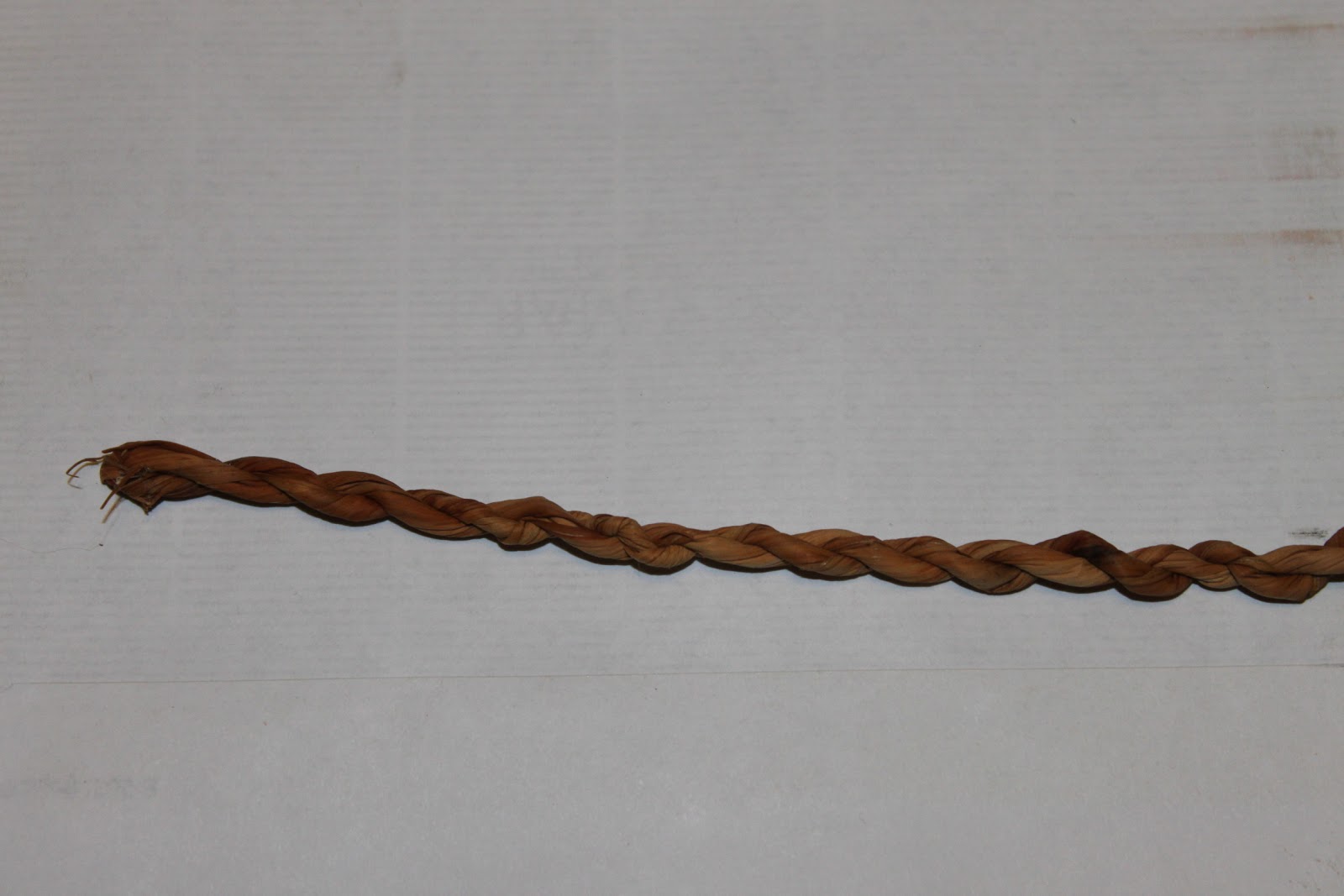
I'm not going into details on just how to braid cattails since there are scads of U-Tube videos on the subject. There just weren't many on how to splice in a new leaf to keep going but that too wasn't much different than what I do making yarn on the spinning wheel. Could I make this cattail cordage on the spinning wheel, not sure, I doubt it. I don't think it will at any stage have the suppleness required.

My biggest issue with this experiment was the breakage.

There is another method of making cordage. I'd guess it would make the cordage last longer as you remove the cellulose from the plant which leaves strings. This I'm sure would lend itself to the spinning wheel. From what I can see and read, the method is basically the same as the process of turning flax into linen. This soaking, beating, and stripping is also on many U-tubes and will be what I'm wanting to try with Milk Weed and Yucca plants.
Tree bark cordage is also made in this fashion and we have a nice willow tree out back so this summer that is also on the list. Ray Mears on one of his shows makes a weak lye solution of hardwood ashes for soaking tree bark that was first lightly beaten. This would speed up the separation of the cellulose from the stringy inner material for he does this whole process in a few hours. Other instructors simply soak the materials until it smells rotten, which is a few days. If time constraits are part of the survival bargain, I can see one method being more helpful than the other. Which produces a better product, don't know.
Also does the renting process make a cordage that lasts much longer than simply using the whole leaf? I can't help but think yes, or why wouldn't they use the whole flax stem instead of renting it to make linen. This refining process I think would make a smoother and more flexible product also.
One critical need for cordage in a survival situation is for a bowdrill to start a fire. Our son has been using paracord for learning this technique. Would natural cordage make a difference? I know cattail cordage is not suitable for this but milk weed cordage is said to do well. And if we are thinking survivalist, then we have to think bow strings too. Hm.... my brain is a whirling now.
One of my problems in researching this subject is that most of the cordage information is from survivalist, not long term self-sufficiency-ists. Okay, there isn't such a word but you get the gist. I'm looking into long term solutions. I can't help it, my brain goes there. I don't have a I've survived for 72-hours so someone has to bale me out now or I'll die attitude. I know this is the bag the government recomends and I agree people should have one because that is about as far as most people are willing to go without a hand out. But I'm not too confident in the government baling me out right now. It can't bale itself out. So I'm thinking more on the line of a survival bug out bag. or sticking tight and making do.
Now of course you can't talk about cordage and not mention rawhide and leather which lasts even longer than cordage made from plant fibers. Besides, I love the look and smell of leather. And rawhide, well it is just classy. I admit, these two materials are calling to me, "Try me, try me!" but first I'm going to work with paracord to learn some basic braids. Then I can use that knowledge to do natural materials whether they be plant, leather or rawhide.
A little research info -- a plant fiber string, in most cases, would have to be twice the diameter of the sinew string to be of the same strength.
Now for that Internet site I mentioned in the beginning and an excerpt from it. Did this last draft have a website mentioned? Oh well, here is one.
http://www.primitiveways.com/cordage_in_North_America.html
"The stem sections of many different plants hold useful cordage fibers. Plants such as nettle, dogbane, velvet leaf, milkweed, prairie flax, thistle, and fireweed are valued for their quality fibers. I have processed many hundreds of feet of stinging nettle, dogbane, and milkweed cordage. These stems are hollow or have a pith core. They are collected in the fall after the last leaves have fallen off, usually after the first frost. The stems are left to dry in a warm place and then they are checked for brittleness. I then split them lengthwise, usually into four sections. These sections are easier to work with. Each section is carefully snapped every few inches, beginning at the bottom. As I snap each small section, I carefully peel the fiber bearing bark loose. Hopefully, I'll end up with a section of bark the full length of the stem. Short sections of bark are still useful as the fibers can be spliced onto longer sections of cordage. As I twist the sections into cordage, the dry brittle bark falls off leaving nice silky fiber. Sometimes the cord has to be twisted back and forth several times to loosen stubborn bark fragments. Some folks use a knife to scrape the bark off the stem before sectioning it but I prefer to just let it fall off while twisting. If you're not careful, you can scrape too deep and ruin the fiber."
I hope this spurs you to make a little cordage of your own. Remember, reading about a subject is great but if you really want an understanding of it -- you have to do it. So stay tuned, this subject isn't finished. I'm not only seeing cordage in a survival sense but wouldn't a bracelet of milkweed be interesting. Of course a braided rawhide or leather one with mammoth ivory pendent would be divine. My daughters would love it for a Christmas present. Oh my, a thought just struck me. What about our yaks long hair? I love horsehair braiding. A yak hair bracelet, now that would be cool!!
Hm... the possibilities are limited only by the mind's imagination and mine is overly busy.
Subscribe to:
Posts (Atom)