 Yes, finally the contest is over and the winner is Goat Lady!!! As soon as I have your address I'll send this wonderful book out to you. Just let me know at hollyrexroat@gmail.com.
*************************************************************************************
 Yes, we are going to talk about you Leta. In fact, she is going to be the naughty example. Don't you mind the look of complaint on her face and her mumblings about the whole thing. If she wasn't so difficult I wouldn't be talking about her. If you've been reading this blog you know I've had an estreus problem with the two older does. Chicory, the two year old, seems to have taken on the first trip to the buck and has a lovely glistening black coat. Today, she gets to be the goat on a pedestal held up as a shining example. Ornery, cantankerous Pudge will be the goat in the middle of the pack. I'm hoping the sourness is due to the fact that she is ten and pregnant. I don't know that. The part about her being pregnant anyway but I'm hoping.
Always the curious one, I looked up the maximum age longevity of a goat and it was 15. I'm guessing it is a weather or a buck. They have the easier lives where as a does milk for 9 to 10 months a year and typically has twins. That's enough to wear anybody out. Of course the chart also said that horses live a maximum of 40 years old. How many 40 year old horses have you met? Me, a few 30 year old ones but not 40.
With that in mind, I think the 15 year old goat is a real rarity.
 Chicory
 Leta
Leta Leta
LetaBut wait a minute I can almost hear you say. Yes, this is Leta and the picture above is Leta. I took a photograph of Leta's from a few months ago and cropped a section of it so you could see how her condition has deteriorated. This is what she has begun to do the past couple years when ever she is pregnant. Her hair will deteriorate even further as she gets closer to kidding. When spring weather takes hold, she may loose clumps of hair and leave somewhat bald patches. That is why this is going to be her last year. Her body can't utilize feed efficiently and so she gives everything to the kids. Leaving kids on her to nurse pulls her down even further and if she's milking heavy, she isn't real pretty either but picks up from her haggard look of pregnancy. With consideration given to her age plus worsening health issues she will be culled sometime this year.
 This picture is a recent comparison of coat conditions. Pudge is the goat standing at the bottom of the picture and Leta is above her. This shot is a good comparison of a coarse, dry, rough coat and a smooth soft one.
*************************************************************************************
 This is a lovely chart if you have memory lapse like I have. Most of the parts of an animal I'm always forgetting. You know the saying that if you don't use it, you loose it. Well, the goats don't care if I use proper language and the only body part they've learned is hooves. Just say, "Let's go trim your hooves." and they'll head for the other end of the pen. They'd hurt my feelings if I thought I was bad at the task but actually I'm pretty nice about it. They just like it about as much as our grand daughters like their hair combed. And while were on the subject, why do we say, "Let's go ....". because let's is for let us and their isn't any us, just me. Then again, maybe I'm the only one who says such silly things. Sorry, I do get off the subject easily. So I apologize if you are a stickler for body part names, I'm trying. I promise to keep the chart handy and refer to it but forgive me if I slip. The kids are all grown and not in
  For this tutorial I'll be looking at the chart so I can use the proper names and not - "You know the cannon area on the front leg? It's that area only it's on the back leg." That is what I told a horse breeder last night when I was describing an injury on his horse's back leg. I know, pathetic and here you probably thought I was smart since I do a blog devoted to education. The secret is that I'm really trying to educate me.
 You may have noticed that in the last two pictures I'm touching behind the front leg on the ribs. The spine should not be sticking up noticeably and there should be only a slight depression visible in the loin area. The ribs should be well covered. You can use an old rule of thumb we learned when showing sheep and beef. Feel the back of your hand. The ridges right before the fingers where the metacarpal bones meet the Phalanges. Yeah, the joint right there. Okay, I looked that up. I know what phalanges are but I wasn't sure where the metacarpal was on the hand.
 The goat's ribs should feel like that spot on your hand when it's open.
 When your making a fist the ends of you metacarpal stick up and are bony. That is what the ribs should not feel like. Go ahead and run you fingers over your other hand. If your goat feels like the first picture with your hand open it is in good body condition. Poor is when your fist is closed. Emaciated is of course when you can count the ribs. If you can't find the ribs then cut back on the feed - the goats too... fat.
 An older does will be slightly sharper in the hip bones due to age - slightly sharper not a lot sharper.
I see many does, way too many, with too little cover over their hip bones and ribs because their belly hangs down and the owner is using that to gauge how fat they are. We have a few things that begin to go south too as we age.
 Leta
Leta Chicory
Your does will naturally change during their different stages but I learned a few interesting things I didn't know from a Washington State University site.
During late lactation goats should have recovered fully and be at the peek of conditioning.
At this point 40% to 50% of the nutrients consumed is going toward milk production. The rest of the nutrients are for the fetal growth and recovery of fat reserves lost during early lactation. (Remember that a couple months or so after the kids are born the doe peeks in production of milk.) Body fat is put on 38% more efficiently during the late lactation period than when she is dry. Let me rephrase that. When a doe is in her late lactation it takes less feed to put her in excellent body condition than when she is dry. Monitor your doe to make sure she gains her condition back at this period and doesn't become too fat as it will hinder kidding and cause metabolic diseases.
During the dry period you are maintaining body condition. It is imparative that a doe be dryed off at least 60 days prior to kidding so that her udder has a chance to regenerate. If she isn't given this period of time her milk production in her next cycle will drop.
Overconditioning increases the chances of metabolic diseases by 43%. These diseases include detosis, milk fever, displaced abomasum and fat doe syndrome. All of these can cause incidences of retained placenta, mastitis, lower milk production and kidding difficulties.
Don't change a doe's condition too rapidly or she will also have metabolic problems as will she also if she is too thin. Basically you have to get it right or your asking for problems. We obviously did when we didn't pay attention to our goats age and their changing feed requirements.
Also it talked about feeding too little grain which lowers energy levels and lowers milk production and if you feed too much grain it lowers the pH in the rumen and it becomes more acidic killing the microrganisms that help the goat to digest fiber which also lowers milk production.
"Feeding more concentrates will not substitute for forage quality and will not satisfy fiber requirements. By feeding high quality forage, the doe's fiber requirements can be fufilled, her need for protein and energy can be met, and you can use a lower percentage of concentrates in the feed ration. Feeding high quality feeds saves you money in your rations and in your herd health. Forages should contain a maximum amount of protein and/or enery allowed for that particular feed." Washington State University. http://smallfarms.wsu.edu/animals/goatfeeding.html
I'd like to add that I too have found that you feed significantly less hay if you have the best quality available. We travel six hours to get one load because of its quality. This time the rancher put up in small square bales in second cutting alfalfa which he usually does a orchard grass second cutting alfalfa mix that our goats thrive on. We will have to cut back a bit further on the grain strength with straight high quality alfalfa hay. We learned the hard way when we bought Leta and she gained weight too quickly ont the straight second cutting alfalfa hay of high quality.
Her first year with us she had a bad case of milk fever. What a wake up call as before that we had always raised our own does and had no problem. They were use to the rich feed program. Here again we are in new territory with old does. We've never kept them this long before. When the kids grew up and there was no more 4-H projects needing young animals, we began breeding our Saanens to Boer bucks and selling the kids. They were easier to get rid of than the fully dairy kids. There's a very small market for dairy goats around here. Actually goats of any kind.
The years passed and our does grew old and once again their feed requirements have changed. Here we go learning and changing once again. I hope this post helps in understanding goat conditioning and how important it is to our goats we love and our pocketbooks for we will either pay in feed or in vet supplies if we get it wrong. I'll talk soon about setting up your exercise pen. Yes, it's the one the goats live in. We learned the hard way what happens if pregnant sheep don't get enough exercise. Believe me, they won't exercise if you don't have a built in system that makes them and that includes most goats.
Congradulations once again to Goat Lady for winning one of my favorite gardening books.


 We had our oldest granddaughter here for four days and during that time we were doing livestock chores for some dear friends. Bundled in ski pants, coat, hat, mittens and her grandma's wool socks tucked inside chore boots our granddaughter trailed after me through muddy wet pens.
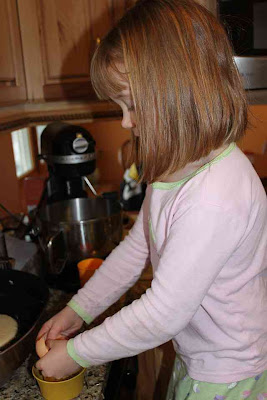 With a kitchen chair slid up to the counter top, she'd crack green eggs one at a time into a cup just in case their were pieces of shell that insisted on remaining with the contents. No biggy as I'd fished them out and she'd dump the eggs into the skillet.
 When we discovered this whopper sitting in the middle of our coop Saturday, she claimed it for Sunday morning. She would have had just eggs for breakfast and Kirk's favorite cereal for lunch everyday if I hadn't insisted that stew and fruit be included.
 I only had to say let's get our chore clothes on and her eyes would light up and she'd be dressed before I'd had time to get my coat and boots on and grab the milk pails. With the additional chores, the time at the corrals stretched on for hours as I walked slowly waiting for her short legs to keep up. And put a few inches of water into a small bucket each time I filled my four gallon ones so she too could help fill the waterers. If I had an arm load of hay she had a five-year-old sized one. She even had to have a try with the pitchfork.
 So this weekend I polished off my teaching skills and talked with our grand daughter about saving the egg shells for the worms in the garden and putting it in the ground so our tomato plants didn't suffer blossom rot.
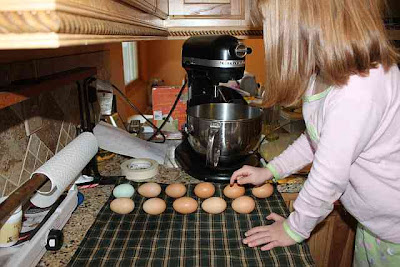 I asked her to help me with washing the eggs. She counted them, putting them in rows of six so we knew how many cartons to bring up from the basement to put them in. I want her to not just know but learn that numbers aren't just squiggly lines on a piece of paper and that math has application. Even when she is just counting to 18 today.
 We discussed the way eggs should be stored to preserve their freshness - pointed side down. Something she may not learn just grabbing a dozen from the store. She insisted they be put in the egg carton pointed end up. I figured it was a five-year-old's creative choice. Not worth arguing over. We'll have this conversation again the next time she comes to help and maybe her choice will be different. Learning is repetitious.
  While we were washing eggs and cooking breakfast, Kirk was in the garage cutting up the hind quarters that he smoked into hams and ham steaks. Breakfast comes first when our grand daughters are here for they wake up with a smile and the first words from their mouth are, "I'm hungry!" When our oldest grand daughter's cute tummy was full, I cleared the dishes and began to wrap the meat. I taught her to make the letter H. First describing it auditorially and then showed her while saying the same words. Then we moved on to the number 10. She already knew how to make an A and a M.

 She further learned that you wrote what was inside the package and the year you placed it inside the freezer. I once cleaned out my mother-in-law's deep freeze to discover that she, a city girl transformed to the country, had written on the butcher paper what was inside and the month and day it was placed there. The ice encrusted sides of the freezer threatened to be categorized as icebergs and I had no idea how many years ago those packages were placed there. She was very ill and 70 some years old. Someone needed to have taught her.
 My oldest granddaughter is sleeping in the bed next to me as I type away. We were at the corrals a long time today as we did our chores, took pictures of the condition of the goats for another post, and took care of the many livestock animals of the neighbors. Kirk, bless him, got the hams and bacons ready for the smokehouse by himself and then hauled a large wheelbarrow of wood down to the basement in preparation for the 2-5 inches the weather man has promised us. We'll see.
 As I searched through the refrigerator for scraps to take to the chickens, a bright flash and a rumble caused me to turn my head toward the kitchen window. Our granddaughter came running into the house wide eyed. "Grandma!"
 They will be poured into a large container and a side of bacon put in to soak. When most of the salt that was rubbed into it has washed off he pulls the side out and empties the water putting in fresh and soaking the side again for a while to draw the salt out.
  The bacons were rubbed thoroughly with curing salt and put in plastic bags to sit to cure on. A couple times a day I flipped the bags over and so they have sat waiting until Kirk was off from work again today. We would like to leave them in the salt cure a shorter period of time but it would tax me lifting the hams in and out of the water and walking up a ladder each time to hang them from the rafters while the water was changed and then in and out of the top section of the smoker.


 As for Pudge, I'm not sure. I'm leaning toward her being pregnant since she is a grouch about hopping on the milk stand and she is pudgier than normal. Chicory on the other hand is due to come in estrus today if she isn't pregnant. On th last possible estrus cycle we left for my mom's birthday party and so she could have cycled later that day or the next but she wasn't cycling when we drove off.


