Monday, October 17, 2011

Gleaning Dragon's Tongue

Remember, I said I was going to try and glean as much as I could from my dried bean patch. Not that the beans were dry but that was what kind of beans they were, the soup kind.

There wasn't much to glean.
It took much longer than I thought for the Dragon Tongue beans to reach the dried bean stage and since I planted them rather late, it didn't happen. Nope, I didn't get the dried beans I wanted.

I know from last year that these purple streaked beans are sweet and yummy eaten fresh but last year I hadn't grown them to the dried bean stage where I could use them in soup. My goal being to find dual crops such as this that can be eaten in different ways, I had planned this past summer to test them as dried beans. No, the two- fresh and dried - weren't going to happen in the same year as our season is very short and my garden not big enough to raise a dried bean patch and a fresh bean patch of Dragon's Tongue.

But undaunted, even though I wasn't going to get a dried bean crop, I still went out to the shriveled mess to see if anything was salvageable for the chickens. It wasn't. But I figured I'd try seeing if any of the fatter bean pods could be opened and the seeds dried for an addition to the stew pot.

Fulfilling my goal this year to learn to use my garden to its fullest.

I began feeling pods searching for large lumps.

As I bent, my poor damaged back soon began to ache. That made me think of my great grandpa on my mother's side. He wasn't a very big man but I pictured him, like myself, bent over searching for a few beans to put in his sack or bowl.

This isn't a memory of my own but one borrowed from stories told by my Aunt and Mom for Great Grandpa died before I was born.  They tell of a sweet little man who spoke very little English and how they use to ask him if they could have something or do something and since he didn't have a clue what they were saying, he'd say, "Yah!", in his native Swedish tongue. They'd then use that as an excuse when they got in trouble with Grandma.

"Grandpa said we could." they'd chorus in defense. 

The same trick couldn't be used on Grandma as she not only spoke Swedish, they both being Swedish immigrants, she spoke English very well also. I'm told Grandma was a domineering socialite who half ran the Baptist church and how could she do that if she couldn't speak the language of her new land? 

Money was tight for these immigrants with a good sized growing family. To help make ends meet, she wove rag rugs on her hand built loom that Grandpa had put together with wooden pegs and sold them.

I know about this little detail because I have the loom. It's in terrible shape with gray weathered lumber and many of the parts missing. Maybe I should just throw it away. I keep saying I'm going to. But as I write, I'm thinking I should take another look at it and see if I can't cut it apart, saving those pegged pieces, to build something else. Something much like a scrap quilt. A quilt like this Grandmother's daughter, my grandmother, made for me and I made for our children by cutting up used clothing and sewing the pieces together to create a blanket of memories and warmth. 

Some of those quilts are pressed firm in my mind as time after time I perched on the bed, staring down at the pieces and reliving the memories they stirred. Surely, I can do something like a scrap quilt, something that would preserved the borrowed memories of my two Great Grandparents.  

I wondered as I worked sifting through the frost wilted patch, how Great Grandpa had the patience to go through the farmers fields after they were harvested, picking up bean by bean until he had a sack full to feed them to put in the bean pot when the cold winds blew.

It took me a while to make my way through the wet wilted leaves, my mind drifted back even further to Ruth and Naomi in the Bible and how they gleaned from the fields of Boaz.
You might not think I got much for my efforts as there were only enough to cover the bottom of a small bowl after I sorted them.

 But it was much more than beans that I gained from my efforts. For a little while, I took a journey back into history and felt what my Grandpa felt. Walked in the sandals of Ruth and Naomi gleaning the very last seed and with this journey, I got to know them a little better. As with many things, it was the journey, not the destination, that held the most reward.
The story might end there except, this week Cliff, in Wilder, Idaho,  contacted me and said he was raising Kinghorn Wax beans for Lisa who is the owner of Amishland Seeds. She saves rare, Organic seeds. 
http://www.amishlandseeds.com/index.htm
He reads my blog and noticed a post about my grandpa Kinghorn's beans. He wanted to know his first name and now, thanks to him and  Lisa, Grandpa's full name, Eldon Kinghorn will be included with the description of the beans in her catalogue.

Thank you Lisa and Cliff, this means a great deal to me and my family who treasure the memories of our dear Grandpa Kinghorn.

As many of you know, I'm really impressed this past summer with the yield of Grandpa's beans. My daughter found similar testimonials on the Internet, so give them a try in your garden.
But what does this have to do with Dragon's Tongue beans? Well,  I really like these three dark purple bean seeds. They are very different from the rest. What if I, like my Grandpa Kinghorn took these three beans and planted them. Just as Grandpa took a few beans that had very small black spots and kept selecting for smaller and smaller black spots until they weren't any. Only, I'd be doing the opposite. Mayby, eventually, I'd gain a crop of dark purple bean seeds.


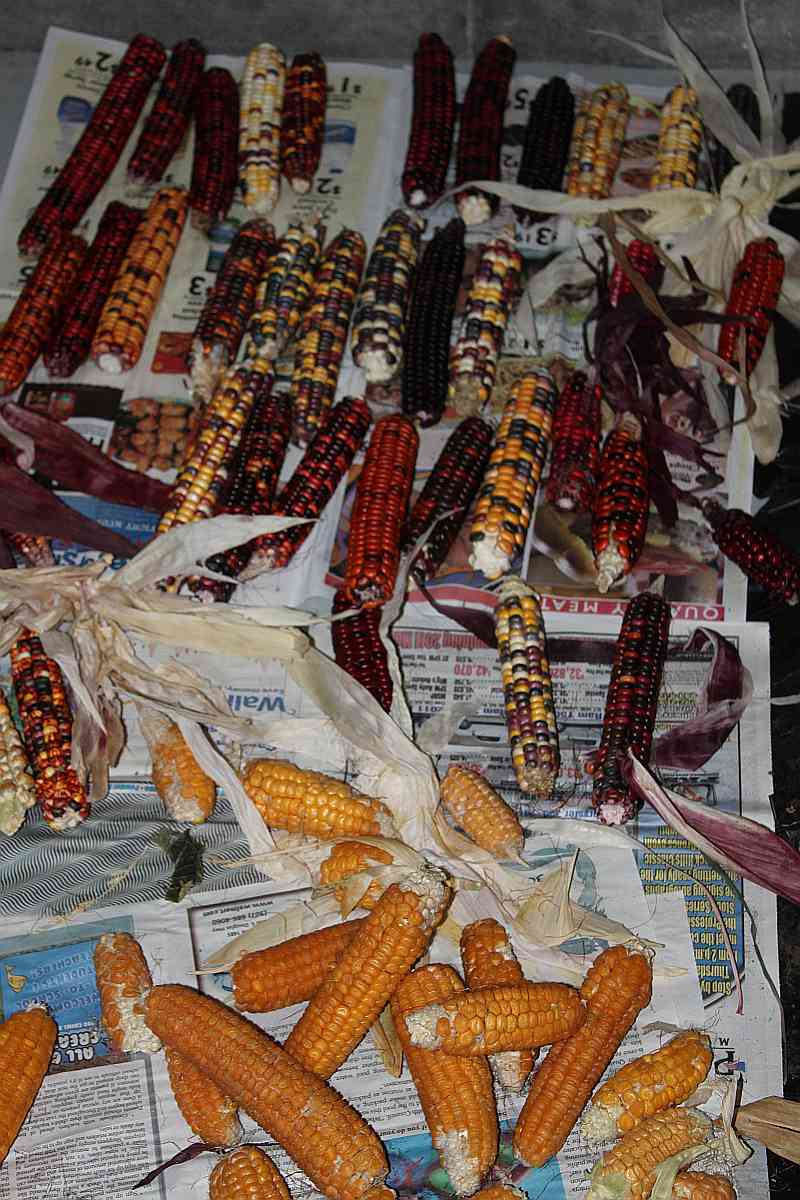
I wonder if they would have a much higher nutrient level and higher antioxidants just like the dark kerneled Painted Mountain corn has much higher levels in comparison to the lighter Painted Mountain kernels? Something to ponder about. 


Friday, October 14, 2011

Busy, During My Down Time

 When I'm resting, watching a program on the Internet, I like to stay busy. Lately, I haven't been spinning, just too tired to pedal but my hands have been busy knitting.

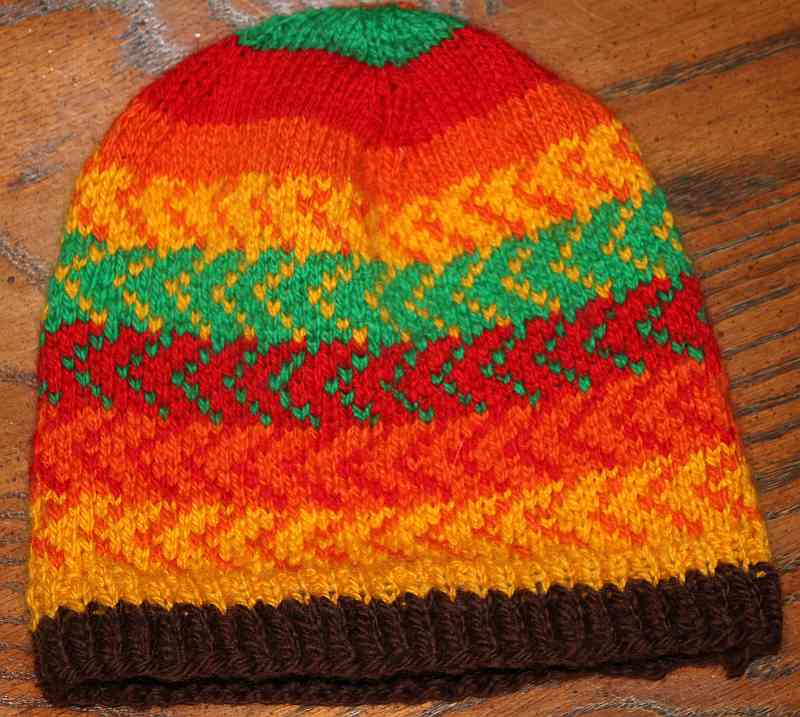
A few of us are going to do an Etsy thing a ma jig and we are making some things to sell. I have no idea how to price what I make but I'm hoping someone else in the threesome does. This crazy small hat is one of those items. It is hand spun and hand knitted. The zig zag pattern is something I saw on a cowl type scarf on the Internet. There wasn't a pattern for the scarf but after studying the picture I came up with my own version converted to fit a hat.

Because each row has two colors, which means two yarns, the hat is extra warm and the best part is it used up a bunch of little balls of yarn I had left over.
 This hat is another of those, yarn left over, projects. The bright neon yellowy - green on the bottom will fold up under and give extra warmth to some one's ears and the stripes will be transformed into plaids. I'll tell you how when I'm finished but my husband is giving me the, "Hurry up." sign so I'd best go. We are going to see his dad and hear all about his trip to Washington.

Wyoming honors its WWII vets by flying them to D.C. for a two day tour. Eighty vets were on this particular flight. I think it is an awesome thing for our state to do. I think they have done one flight per year and they must be about at the tail end for Kirk's dad was serving during the last part of the war.  

Do any other states in the U.S.A. do this?

Thursday, October 13, 2011

Harvesting Sunflower Seeds.

 I picked all but a couple sunflower heads today after cleaning out the storage shed. I've wanted to grow sunflower for quite some time now but frustration reined every time I looked in a catalogue. The descriptions told what color the flowers were and just how beautiful they are but zip -- zilch about the seeds.

And though sunflowers, what ever color they are, are one of my favorite flowers, I was growing them not just to look at but for their seeds. 

Those of you who feed the birds know that black oil sunflower seeds are what you see in all the birds feed mixes. I buy fifty pound bags of black sunflower seeds to mix with my other livestock feed. One mixture I feed to my chickens and another to my goats. Cattle also benefit from eating black sunflower seeds but I haven't put the yaks on them yet. Maybe this winter when they need more nutrition and calories to stay warm. As for horses, I'm not sure if sunflower seeds are recommend for them or not.

As part of my new effort to grow a little feed for my livestock so I'd know how if I had to in the future, I decided sunflower seeds would be a good place to start.

Organic seeds of course since my garden has nothing but that. And now that I've watched a film on the Colony Collapse Disorder in bees, I definitely want nothing else but. They think they have found the reason and it is a new type of pesticide that was introduced to crops. It is pretty scary stuff but I'll talk on that later.

My catalogue search go me nowhere and then I became busy with other projects. Looking back on it, I guess I should have called some catalogue companies but calling is something I don't do well. Not that I don't have phone manners but for some reason I prefer face to face and have a hard time making myself pick up the phone. I'm guessing it has something to do with my Autism for I've had the problem since I was old enough to talk on the phone.

 Anyway, in frustration, I just grabbed a couple packets of Martha Stewart's organic sunflower seeds off the rack at the hardware store and popped them in the ground with a Doris Day kay... ser...aw, ser...aw, what ever will be will be, attitude.

Sure enough, what I'm harvesting is people sunflower seeds. How do I know, well, the seeds are white with gray streaks, not black. 

What do I care since both the gray striped and the black striped can be fed to birds and livestock? Something I know for a fact because the birds have been helping themselves to sunflower seeds still on the plants in the garden and of course the Internet said so. 

 So why are commercial black seeds in bird seed mixes and not the white with gray striped even though the white with gray striped seeds are larger? Because black sunflower seeds have more nutrition and are higher in calories than the gray ones. The black are also meatier having a larger seed to shell ratio and the shell is thinner making it easier for the birds to crack.

I'd guess the size difference is why people get the gray ones and animals and birds the black ones. Maybe the gray ones taste better too, not having as much oil in them. I don't really know, I guess I should crack some of those black ones I have for the livestock and find out. 
I do know that this head is not ready to pick even if my fingers were strong enough to dislodge the seeds from the head. See how white the seeds are? They are plump which is what you want but the gray stripes haven't appeared yet. It is when the stripes appear that the birds appear eating the seeds on the outside of the heads where they ripen first and work their way toward the center.
Plump and striped is the two key things you look for but even at this stage it takes some strong fingers to work the seeds out. I'll clean out the vegetation and then spread out the seeds and let them dry some more. When they are fully dry, I'm going to salt some like you do pumpkin seeds and the rest I'll mix with the rest of the sweet corn I'm shelling. The last batch went to the chickens.

As for what I'm going to do next year, I'm not sure. I definitely want to go organic and I guess I'll have to do that thing I don't like to do and make a few phone calls to the organic catalogues companies that I use each year and ask them which of their sunflowers produce black seeds. 

And I'll tell you all about the film on bees which tells the tale about the search for the missing bees and the cause in another post. For now it is chore time and that means supper time for us too.

Tuesday, October 11, 2011

Flakey, Crisp Hashbrowns

Don't you wish you had had breakfast with me this morning? It was yummy even though my husband, if he were here, would have complained, "Where's the toast?"  

Yes, it was only me for breakfast and since I'm worth it - I fixed sausage, fresh pullet eggs, hash browns, and sliced a peach.

I love a hearty breakfast. Only I want mine between 9:00 and 10:00 in the morning. Not that I'm not up a whole lot earlier but for some reason, I just don't want to eat. My doctor says most people aren't ready for an early breakfast because their cortisol levels are highest in the morning and that supresses hunger. Cortisol peaks around 8:00 am but obviously that isn't true with me since I have Addison's disease and don't produce my own. One of the reasons I'm so grateful for modern medicine.
This morning, the food I was really craving the most was hash browns. You can tell my ancestors are from Idaho. And, I wanted REAL potatoes. Not those imitations things from the store.

 Some of you are saying, "But mine never turn out. They end up this gray blob of glue instead of a nice flaky crunchy delight." Can you call hash browns that aredn't glued together flakey? Anyway, I've been there. So I then started boiling or baking potatoes to make into hash browns. Somehow it wasn't quite the same.

Then I discovered the culprit that caused the gluey, gray mass and pre-cooking went out the window.  

Now I wash my potatoes. No, I'm not talking about the initial washing to remove all the soil from the outside, though I do do that also. I'm talking about washing to remove much of the starches that cause the color change and glue like texture. And now I have to put my potatoes in a pile in the pan pushing them together to get them to form a patty. 

Maybe I had better just start at the beginning.

With a grater, preferably a microplane grater since they are awesome, grate a medium potato per person. Be careful, since
this grater doesn't mind taking a little flesh along with the potato.  
Place the grated potato in a strainer. (I don't peel my potatoes so I make sure the outsides are scrubbed well before grating them.)

And, then head for the sink. Note how quickly the potatoes gain a brownish red cast after grating them. This is the starch. To really notice it, place a bowl beneath the strainer and turn on the cold water. Rinse, and rinse, and rinse until the water no longer has a brownish red cast.
And, your potatoes are a creamy white color.

Then press the potatoes against the side of the wire strainer to press out some of the water. Next, place the potatoes in paper towels or a more eco-friendly cotton dish towel and press the towel against the potatoes to remove as much moisture as you can. I keep a few of these handy towels just for food purposes. They are never used to dry dishes.

Meanwhile, heat a skillet until it is hot, add a little oil, and then the potatoes.

Don't get in a hurry to stir or turn the potatoes. Sprinkle a little ground black pepper and salt on top, then let them cook until the underside is crispy before turning.

Bye, bye gray color and glue. Hello crispy potatoes that don't stick cling together.

Now admit it. Aren't you craving hash browns too?

Thursday, October 6, 2011

Thinking About Hard Times

As for the garden projects, I have more sunflower heads to cut and shell. Then there isn't much more to gather from the garden. I do want to pick beans off the shriveled, frosted plants. I had hoped they would reach the seed saving size but alas, so I'm going to try to see if the chickens wouldn't eat the over sized beans.


And while I'm talking of gleaning from the garden, will the livestock relish old yellow and dry corn stalks? I've set a goal this year to harvest my garden to its fullest level. Ignorance I'm sure will prevent me from doing as much as is possible but with each step I will grow closer to using all that the Lord hath given me.

It isn't that every crumb is necessary, but one day soon it may well may be, for many of the leading experts are saying next year the world will sink into a depression. One that will make the last one pale in comparison.

This mess we've gotten ourselves into could get really ugly with fewer skill available than the last depression. Think about it. Who knows how to cook completely from scratch? How many can raise a self-sustaining garden? Who is knowledgeable about raising livestock in the most basic way. I mean by this that they aren't running to the feed store for pre-packaged livestock feeds. That they know for instance that pumpkins are very good for goats. I have just learned this. I know in the book Farmer Boy they fed them to the cows and I guessed they were good for goats too but I didn't really know for sure until recently. Now I need to see if I can get my girls to eat part of my surplus pumpkins. How many of you can sew? How many of you can do basic vehicle mechanics, a little plumbing, a little electrical, a little woodworking etc. In general, how many of you can take care of yourselves.  
This may shock you, but I considering myself and my husband one of those people who are dependent

Don't scoff. The more I learn, the more I realize I haven't a clue about how to be self-sufficient. For instance, if we had to save seed and grow another garden from those seeds creating a crop true to its parent, we'd be in a hurt since we really don't know how. Oh I've got a few books on the subject but you and I both know that books are only a jumping off place to the unknown.

Everyone's soil and climate is a bit different changing some of the information in the book. It's like reading the birthing process of goats and then spending the next few hours trying to explain to your laboring doe that she is doing it all wrong. "No, the back feet don't come first, and aren't you suppose to be dilated more?" Your goat of course has no idea because she's never read the book and doesn't care anyway. 

It's this base knowledge that very few things are as simple as they first appear that grounds me for the more I learn, the more I realize how little I really do know.  If pressed to live off what we produced, we'd be mighty uncomfortable.
When I think of the days ahead I think of Kirk's (mother's) father who during the Great Depression worked for the railroad as a steward - six days a week. He only had a few holidays off. He didn't spend his days whining about how bad he had it. He was just glad to be employed.


I think of Kirk's father's dad and the stories of how his folks and siblings survived the depression on a ranch in Montana. Kirk's dad is the child in the middle.
Clothes weren't none too fancy (notice the one size fits most jumpsuits) and shoes... well, note those bare feet.
 The little red head on the right with the unruly hair is Kirk's dad. He tells of getting up in the frosty morning to  herd the goats and cows in to be milked. On the journey, he'd sometimes stop to stand in a freshly deposited cow pie, (manure) to warm his feet which ached from the cold. Shoes were for school.

These are some of the pictures that adorn the walls of our home, reminding us of just how blessed we are. Reminding us of that history repeats itself and it's due for another round of hard learned lessons about frugality, living within our means, honesty, and integrity.

Yes, when I look at the moral character of those in the 1930's and realize how these good people were refined through hard times, it isn't any wonder they were called 'The Greatest Generation" after WWII was over. These already good people were made even greater by the sacrifice bore well once more.  

Think today of our young and adults. What would our entitlement spoiled culture do during a Great Depression?

 And mind you one of these days there will be a depression. History always repeats itself when lessons fail to be learned from it. So it might be next year or a few year yet but this world needs arighting. Greed and self-centeredness have twisted it all askew.  My fear is like the spoiled little rich girl that doesn't get her way, things could become mighty ugly before they are fixed once more.

Wednesday, October 5, 2011

Hay

Sorry, but since I need to leave to go and haul hay, I had to use an old picture of our hay shed when with a borrowed tractor, Kirk was putting grain inside.

I took the day a bit easy yesterday. I wouldn't say I did nothing for I did changed beds, straightened up the house- particularly the kitchen- did a little knitting, and had a really good laugh with a girl friend on the phone. But, over all I didn't do anything big. Oh yeah, I guess in the early morning I did stack three fourths (about 2 1/2 tons) a trailer of hay into the shed but that was done was ten. 

And the funny thing is I was rather depressed in the afternoon. I think it is the let down. Not that I was feeling let down but that I had a little while for my emotions to catch up with the stress load I'd been carrying. In my sad mood my poor husband had to settle for a store pizza for supper. He is such a good man.

But today I have to 'buck up' as we say and push my emotions aside because I've hay to haul from South Dakota and stormy weather is a brewing. That means the hay needs to be tucked inside the shed and covered with plastic since the shed is not weather proof.

If you can even call it a shed since it once was a piece of machinery that a rancher pulled behind his tractor. An auger was attached and hay was shot into it, compacted by a treadmill like base, and the hay came out of it in the formed a loaf.

The rancher had removed the bottom when I spied it and my little scrounging mind thought - hay shed. A little negotiating and it came home with us. We had good intentions to fill in the end and cover the vents but it just has never happened. None the less a good heavy sheet of heavy plastic works to keep the moisture that seeps in off our hay and it is far far better than setting outside and trying to keep it covered. We always lost a lot of hay to the weather when we used that method.

 The least enjoyable part of the whole haying project is shimmying along the top of the hay bales that reach nearly to the roof and spreading a HUGE piece of heavy plastic while dragging pickup tires to lay on top. Some how that job always falls to me.

This year we vow to not waste any of our expensive hay. Not only by preserving it in our shed but by buying efficient hay feeders and hopefully rebuilding another. You see I've my eye on a broken down hay feeder in a field but I can't find anybody home at the trailer nearby to try and make a deal for it. Beyond that hope, we've two more hay feeders to buy. 

"A fool and his money are soon parted" said Benjamin Franklin ( I think that was who said that.) and this fool is going to start being smarter about wasting money by wasting hay. My goal is to not allowing any to be used as bedding by the animals instead of food. You livestock owners know how it is for stock invariably spread their hay on the ground as they sort through it to find especially tasty morsels. Then of course they urinate and defecate all over it while they are looking for the tasty morsels and then of course they won't eat the hay on they've soiled.

"Waste not want not." has become a higher priority in this household - hay being one area that it is critical to be more frugal with. The price this year is especially high since the drought in Texas and Oklahoma's has caused semi after semi load to leave the country to feed their livestock. Otherwise we'd have low hay prices since the farmers and ranchers had an abundant crop.

So my advice to you new livestock owners. Don't just put your hay under plastic. Work towards building or scrounging something to use as a hay shed. You'll save hundreds of dollars each year as the weather won't be starting a mold factory in your hay stack and robbing you of your hard earned dollars.

Plus, use hay feeders and good ones for the bad are no better than just throwing your hay on the ground. Remember hay on the ground picks up worms and those worms then journey inside your stock.
I'll talk more later about my search and research into the area of hay feeders.
   

Tuesday, October 4, 2011

Harvesting

Silence yesterday meant I was putting the pedal to the metal and pushing. I've one more load of hay to haul which is a six hour trip. Yes, we are picky about our hay and none of this baling it all day garbage will do for us. I want my hay from the second or third cutting and baled when a little dew is on it. Not many farmers really know how to bale GOOD hay and I found a gentlemen who knows what he's doing so we travel six hours for a load. It is worth it for the nutrition value is much higher. In fact, this gentlemen gets paid by the nutrition value, the higher it is the more he gets paid by a dairy and his less desirable hay goes to a beef feed lot.

Better hay means you don't have to feed as much and you get a much better result without feeding grain supplements which is more expensive to feed than hay.

Kirk and I went for the first two trips but he had to go to work and the second load was still on the trailer when Monday morning arrived along with the grand kids.

The oldest two munchkins went to school but the youngest is home all day with me and I wasn't about to start throwing sixty pound bales of hay around. Okay, I don't throw them at my age, actually I just do more of a drop kick. My husband laughs but hey, it does the trick.

So instead of stacking hay, I canned tomato sauce from some of the ripened tomatoes that were laying on newspaper in our basement. Then I sliced a bunch more tomatoes to dry in the dehydrator for tomato powder for noodles. I then made soup with some of the sauce and photographed it to take to the rec-center to put in fliers to advertise the soup cooking class I'm giving in a couple weeks.
And to prove this grandma is not all work and no play I took our youngest grand daughter to the park to help wear her out for a long nap. Yes, I might be conscrewed as devious at times but I needed some time without her help.

Afterwords she ate lunch and I read the same Scooby Doo book I always am forced to read before her nap time. After she was asleep, I went out to the garden and dug potatoes. I also found a few little beets I can chop up and dry for beet powder. The potato crop was horrible in the area that had buckwheat growing but the patch by the sunflowers did very well. That's is one of the reasons you grow a crop in more than one place. If I had all my plants in with the buckwheat I would have very few potatoes for the winter. I won't mix the two again - lesson learned. It wasn't too bad a crop with the big ones filling a fruit box.

And the little ones I put in a couple fruit box lids. We don't need very many potatoes as I've nowhere cold enough to store them for a long period of time. About the end of February they begin to sprout and at that point I cook and freeze them. I'm not too fond of canned potatoes so I've long ago quit doing it. 


For a break, I sat and shelled some of the sweet corn I'd picked last week. A little that was left in the garden and had dried on the stalks.


It will be fed to the chickens as I've still some from last year to make into corn bread. There are a few more cobs of sweet corn in a small pile in the basement drying for another day and another break.

Meanwhile, I'll continue to shell the Painted Mountain corn.


At three I picked up the older grand kids from school, fed a snack and... and... and... you know how it is with kids. 

After they left I was notty and rested for thirty minutes past the time I had taken out the tomato sauce from the hot water bath. The sun was setting by then and I had a trailer of hay waiting to be stacked in the shed.

It gets a bit exciting peering into the shadow to find your footing and I'm not real sure where I put my hay hooks. I know they are embedded in a hay bale but I'm hoping it was in one high enough that I didn't burry it when it became really too dark to see.

Oh well, I'm not babysitting this morning except to take the girls to school and I'll get the rest of the four ton stacked in the shed so I can call about getting another load hopefully tomorrow. So if you don't hear much from me this week know I'm swamped and somewhere in between all the work I've got to find time to help my husband get ready to go elk hunting this weekend. For us, fall is the busiest time of the year.